
About the Marion County County Court
Florida runs a two-tier trial-court system. The Marion County Circuit Court is the trial court of general jurisdiction. The Marion County Court is the trial court of limited jurisdiction. Each of Florida's 67 counties has at least one county court judge. The Marion County Court takes the smaller and shorter cases. It moves a high volume of Marion County misdemeanor, traffic, and lower-value civil work. The Marion County Court sits inside the Marion County Judicial Center in downtown Ocala, in the same building as the Marion County Circuit Court.
The Marion County Court is not a junior version of the Circuit Court. It is a separate trial court with its own jurisdiction line, its own judges, and its own appeal path. The two Marion County courts share staff and clerks, but the cases do not mix. A felony does not land here. A divorce does not land here. A claim above the Marion County Court dollar limit moves up the hall to the Circuit Court. That dollar split was raised to fifty thousand dollars under recent Florida legislation, so the Marion County Court now reaches more civil disputes than it did a few years back.
Marion County Court cases are filed with the Marion County Clerk of the Circuit Court and Comptroller, Gregory C. Harrell. The Clerk indexes the Marion County Court docket, redacts confidential data, and posts records to the public search portal. The Fifth Judicial Circuit assigns judges to Marion County Court divisions. The same Circuit 5 site that lists circuit judges also lists Marion County Court judges.
Marion County Court Jurisdiction
The Marion County Court's jurisdiction is set by Florida statute. It covers a clear, limited list. Some categories are criminal. Some are civil. Some are quasi-civil, such as traffic infractions and ordinance violations. The Marion County OCRS case-type codes reflect the split. MM is misdemeanor. CT is criminal traffic. TR is civil traffic infraction. SC is small claims. CC is county civil. CO is county ordinance. MO is municipal ordinance. IN is non-criminal infraction. AP is an appeal from Marion County Court that lands back in the Circuit Court.
- Misdemeanor criminal cases punishable by up to one year in the county jail.
- Traffic offenses, both criminal traffic (CT) and civil traffic infractions (TR).
- County ordinance and municipal ordinance violations.
- Civil disputes up to $50,000, including consumer, contract, and personal injury claims.
- Small claims up to $8,000 under simplified summary-claim procedures.
- Landlord-tenant matters, including residential evictions.
The Marion County Court also handles first appearances after arrest, sets bond on lesser charges, and conducts preliminary hearings in felony cases before the file is bound over to the Marion County Circuit Court. That last role matters. Many people first see a Marion County Court judge for a probable-cause hearing or bond review even when the case is destined for felony court upstairs. A Marion County circuit judge then takes over once the State Attorney files an information or the grand jury returns an indictment.
Marion County Court Judges
Marion County Court judges are listed on the Fifth Judicial Circuit site. The Fifth Circuit covers Citrus, Hernando, Lake, Marion, and Sumter counties. The Marion County roster mixes circuit judges and county judges in one published list. Each judge keeps a public procedures page through the Fifth Circuit judiciary page. Those pages list courtroom assignments, hearing types, and contact rules. Judges cannot discuss pending cases outside the courtroom, by order of the Code of Judicial Conduct.
The county-court bench in Marion shares the Judicial Center with the Circuit bench. The 2010 building expansion added five new courtrooms, a jury assembly area, hearing rooms, and offices. That space helps the county court keep up with high-volume misdemeanor and traffic dockets. Robert E. Landt, LeAnn Mackey-Barnes, Thomas P. Thompson III, and Lori Cotton are among the county-court level judges on the published list. Confirm the current courtroom assignment on the Fifth Circuit judiciary page before any hearing.
Note: County-court judges may rotate between divisions or be assigned to specialty programs such as Mental Health Court, Misdemeanor Drug Court, Teen Court, or Veterans Court, so check the daily docket for the right courtroom.
Misdemeanor and Ordinance Cases in Marion County
Marion County misdemeanor charges are filed by the State Attorney's Office for the Fifth Judicial Circuit. The Marion County Court hears them under court-type code MM. Typical misdemeanors include first and second degree state offenses such as battery, theft below the felony threshold, driving with a suspended license, DUI in many cases, possession of certain controlled substances, trespass, and resisting an officer without violence. Criminal traffic (CT) cases include driving under the influence, driving while license suspended with knowledge, leaving the scene of a crash, and reckless driving.
Marion County and city ordinance cases fall here too. CO covers a county ordinance such as a Marion County code violation. MO covers a city ordinance from Ocala, Belleview, Dunnellon, McIntosh, or Reddick. Penalties may be a fine, community service, probation, or short-term jail in some cases. The Marion County Court case file holds the citation or charging document, plea, disposition, fine ledger, and any warrant or capias for failure to appear.
For a deeper look at felony and misdemeanor arrest tracking, see the Marion County arrest records page. Sealing and expunging Florida misdemeanor records is governed by Florida Statute 943.0585 for expunction and Florida Statute 943.059 for sealing, both run through the Clerk's Sealing and Expunging counter.
Traffic Cases in Marion County County Court
Traffic is the heaviest county-court docket in Florida, and Marion County is no exception. Marion County civil traffic infractions are coded TR. Criminal traffic is coded CT. A speeding ticket or a careless-driving ticket starts as a TR. A DUI, a driving while license suspended with knowledge, or a leaving-the-scene case starts as a CT. Both move through the Marion County Court but follow different rules. A Marion County traffic infraction can often be paid online, contested at a hearing, or resolved through driver-improvement school. A criminal traffic case follows criminal procedure, including arraignment and plea.
The Clerk records the citation number, the charge and statute, the officer and agency, the hearing date, the disposition, fine and costs, school election where allowed, and the payment status. The driver-license history at the Florida Department of Highway Safety and Motor Vehicles is a separate record. A traffic court file is not the same as a driving record. For a full walkthrough of citations, school elections, and DUI handling, see the Marion County traffic court records page.
The third image is the Florida Senate page for Florida Statute 28.24, which sets statewide service charges for clerks including many traffic-related charges. The Marion County Clerk applies those charges on top of the base fine when a citation is paid late or contested.
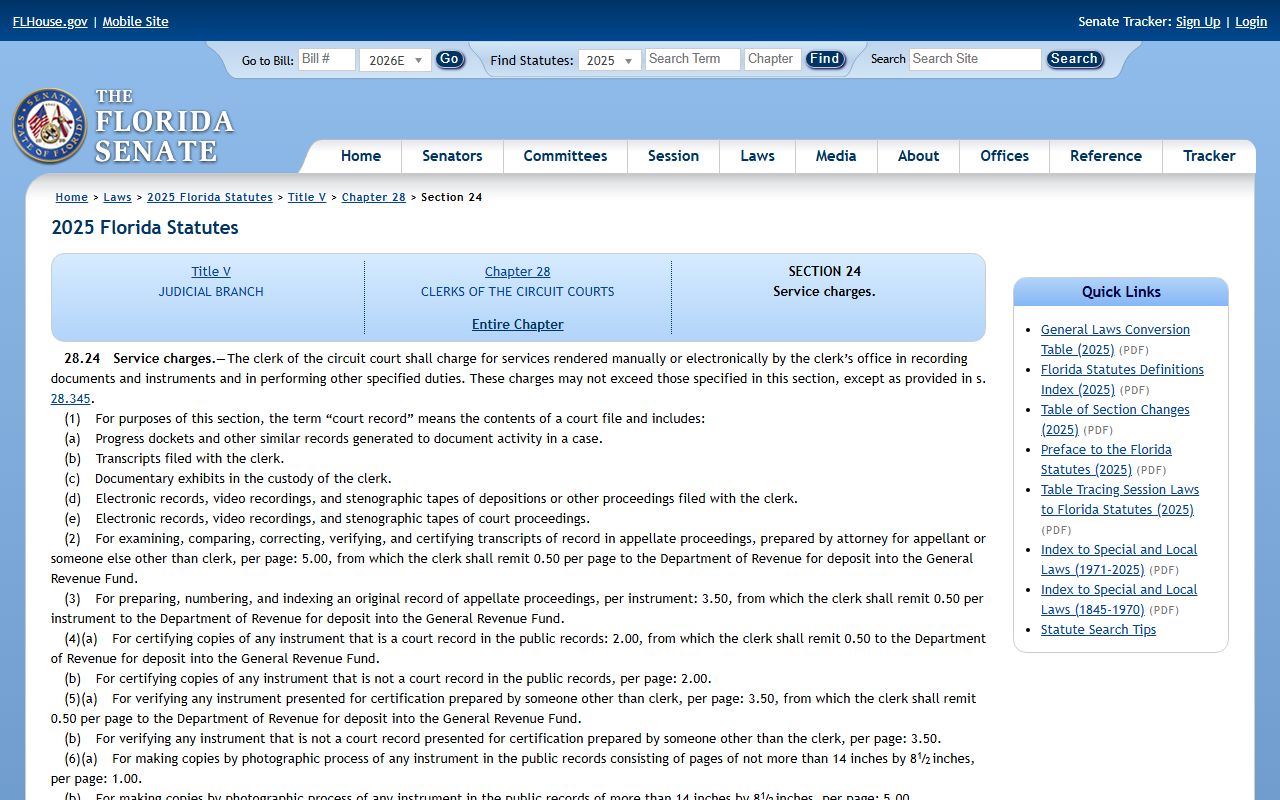
That statute is the legal backbone for how the Clerk bills filing, copy, recording, and certification work across the county court system.
Small Claims and Civil Disputes Up to $50,000
County civil cases are coded CC. Small claims are coded SC. The split is based on the amount in controversy and the rules that apply. Small claims uses Florida's Small Claims Rules, a simplified procedure designed for parties without lawyers. The cap is eight thousand dollars, not counting attorney fees, court costs, or interest. Above that, the case is filed as a county civil action up to the fifty thousand dollar limit. Past fifty thousand, the case goes to the Circuit Court as a CA case.
Typical small-claims cases include consumer disputes, return of a deposit, minor auto-damage claims, unpaid invoices, and disputes between neighbors. The court holds a pretrial conference soon after service. Many cases settle at that pretrial conference. If not, a short trial follows. Many parties appear without a lawyer in small claims. Marion County Court keeps small-claims and county-civil dockets separate, and the OCRS court-type checkbox lets searchers filter by SC or CC.
A sample county civil case path looks like this: file the complaint, pay the filing fee, serve the defendant, wait for an answer, attend mediation if ordered, take part in the pretrial conference, and proceed to trial if no settlement is reached. Final judgment closes the case unless an appeal is taken to the Circuit Court appellate division.
- File a Statement of Claim or complaint with the Clerk and pay the filing fee.
- Arrange service of process on the defendant.
- Attend the pretrial conference; many cases settle here.
- Attend mediation if ordered by the court.
- Go to trial in front of a county-court judge if no settlement is reached.
Marion County Evictions and Landlord-Tenant Matters
Residential evictions are filed in the Marion County County Court. The Clerk runs a dedicated evictions counter and forms set. Forms can be printed at no cost from the Clerk's evictions page or bought in person at Room 204 for $0.15 per page. The forms cover three-day notice for nonpayment of rent, seven-day notice to cure or quit, the complaint for eviction, the summons, the writ of possession, and related motions. Landlords who file pro se must follow Florida Statutes Chapter 83 to the letter; a wrong notice can sink the case.
An eviction case is fast by court standards. The defendant gets a short answer window. If the tenant does not pay rent into the court registry while the case is pending, the landlord often gets a default judgment. The Clerk then issues a writ of possession to the Sheriff. The Sheriff serves the writ and gives the tenant a 24-hour window before lockout. The county court docket carries the case start to finish.
The second image below is the Marion County Clerk's Marriage License Kiosk page, which sits in the same Clerk system as evictions and small claims and shows how the office routes self-service tasks.
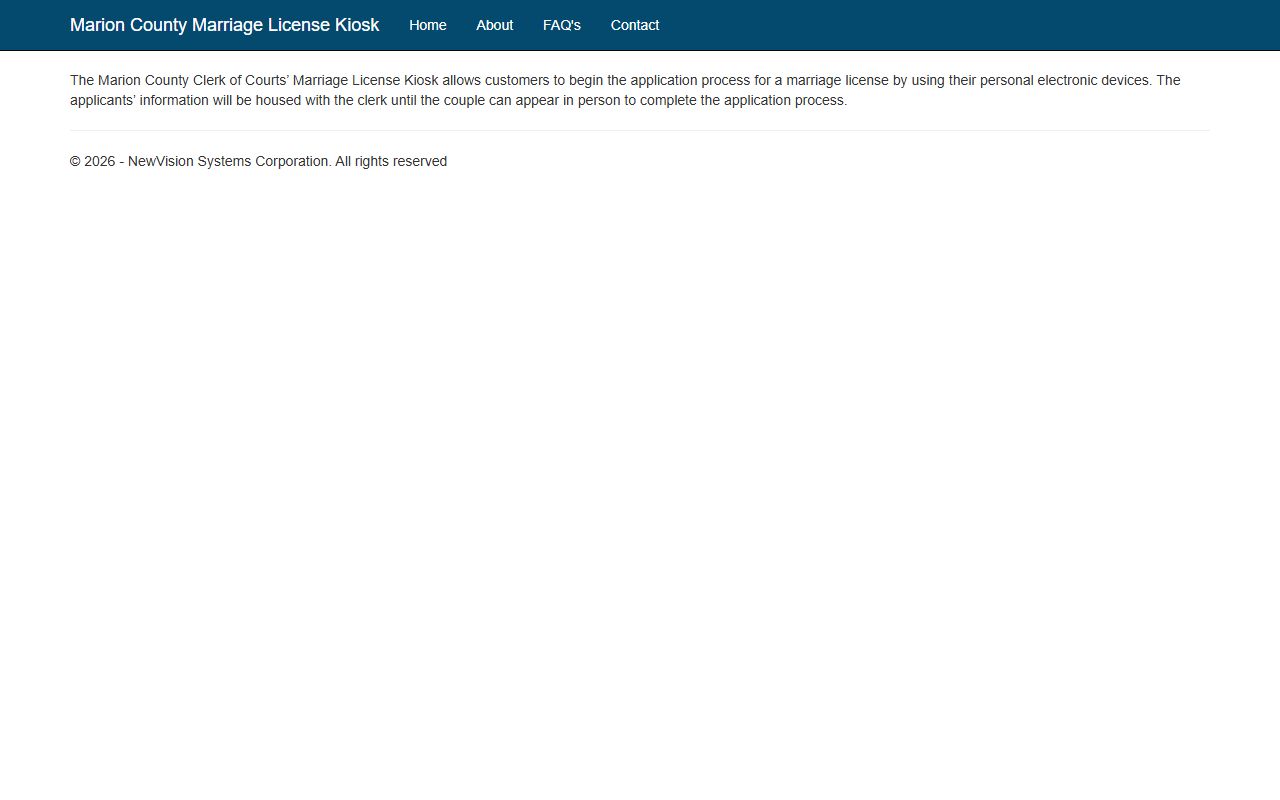
That kiosk handles marriage paperwork on the family-records side; for the divorce side of family law, see Marion County marriage and divorce records, which sit in Circuit Court rather than County Court.
How to Search Marion County County Court Records
Marion County Court cases are searched in the same portal as Circuit Court cases. The Clerk uses Civitek OCRS. The portal lets a public user search by person or business name, narrow by date, and filter by case-type code. County-court matters use the codes MM, CT, TR, CC, SC, CO, MO, and IN. The portal screen first asks for a choice of Public, Attorney, Registered User, or Party Access. Public access is anonymous and does not need a login.
- Open the Marion County Online Court Records Search.
- Select Public and accept the disclaimer.
- Enter a last name or business name, plus first name if known.
- Tick the right court-type box, such as MM for misdemeanor or SC for small claims.
- Set a filing date range if results are too broad.
- Pass the robot check and press Search.
- Click into a case to see the docket, hearings, and any public documents.
Sealed cases, juvenile cases, and confidential filings do not appear in public search results under Florida Rule of General Practice and Judicial Administration 2.420. The Clerk also redacts protected data, such as Social Security numbers and bank account numbers, under Florida Statute 119.0714. For a complete walkthrough including field-by-field search tips, see the main Marion County court records page and the court dockets page.
The first image is the Florida Senate page for Statute 119.0714, the law that governs court file privacy at the Clerk.
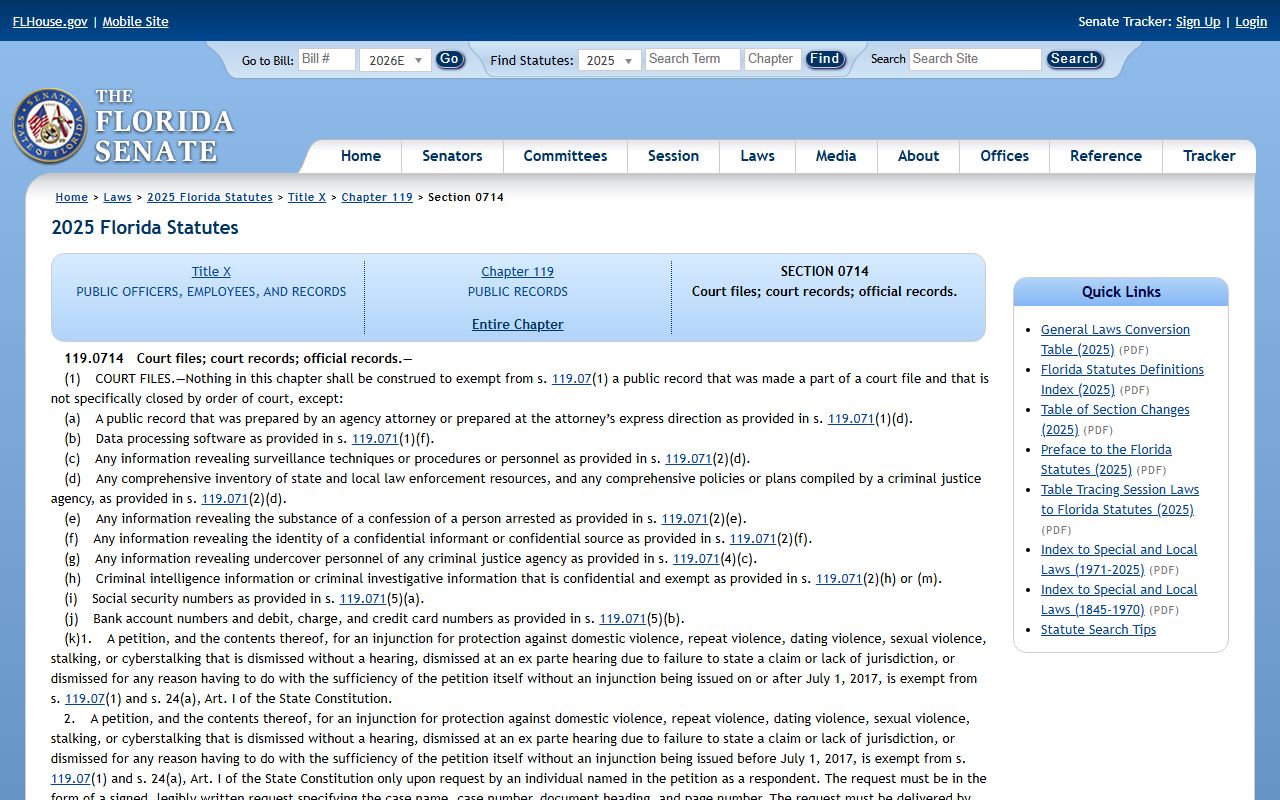
That statute names the data points the Clerk must redact before a county-court file goes online or over the counter.
County Court vs Circuit Court
The split between the two trial courts is set by statute and dollar value. The table sums up the lines a Marion County searcher needs to know.
| Marion County Court | Marion County Circuit Court | |
|---|---|---|
| Civil dollar limit | Up to $50,000 | Above $50,000 |
| Criminal scope | Misdemeanors, criminal traffic | Felonies |
| Family, probate, juvenile | No | Yes |
| Small claims | Yes, up to $8,000 | No |
| Evictions and landlord-tenant | Yes | No |
| Appeal route | To Circuit Court appellate division | To Florida District Court of Appeal |
| OCRS codes | MM, CT, TR, CC, SC, CO, MO, IN | CA, CF, DR, CP, GA, AP |
| Filing fee range | Roughly $55 to $400 | Roughly $400 to $1,900 plus add-ons |
The two courts share staff, share the Judicial Center, and share the OCRS portal. They do not share jurisdiction. A wrong-court filing is bounced or transferred at the Clerk's intake desk. Filers should confirm court type before paying a fee.
Filing Fees and Service Charges
Filing fees in the county court are set by statute. The bulk of the schedule sits in Florida Statute 28.24, which covers Clerk service charges. The Marion County Clerk publishes a full ADM Schedule of Service Charges PDF that lists the current line items. Fees are paid at filing. Some cases also pay summons issuance, certified copy, and recording fees on top of the base filing fee.
| Item | Fee |
|---|---|
| Plain copy at the Clerk counter | $0.15 per page |
| Eviction forms purchased in Room 204 | $0.15 per page |
| Eviction forms printed from Clerk site | Free |
| Sheriff certified case-report copy | $1.00 per page |
| Certified will copy at probate counter | $1.00 per page plus $2.00 certification |
| Marriage ceremony fee | $30 |
| Additional certified marriage ceremony copy | $3.00 each |
The Clerk's fee PDF controls in any conflict with a quote. Filing fees for civil claims rise with the amount in dispute. Small claims has tiered filing fees set by claim size. Civil traffic and criminal traffic carry their own statute-driven costs plus the base fine. Indigent filers may apply for a fee waiver using a Florida Application for Determination of Civil Indigent Status. The Clerk reviews indigent applications and issues a determination on the case file.
Appeals from Marion County Court
An appeal from the Marion County County Court goes to the Marion County Circuit Court. This is the appellate division of the Circuit Court, not the Florida District Court of Appeal. A county-court loser files a notice of appeal with the Clerk and pays the filing fee. The Circuit Court reviews the record on appeal, accepts briefs, and may hold oral argument. The appellate-division case is coded AP in OCRS.
The standard of review is set by case type. Most county-court appeals turn on whether the trial judge applied the law correctly or whether the record supports the verdict. A Circuit Court appellate decision can be the end of the road for most county-court cases. A small subset reach the District Court of Appeal through a discretionary writ of certiorari. The Florida Supreme Court is rare for a county-court chain. Federal questions can move to federal court only in narrow situations and are not appeals in the ordinary sense.
Marion County Court Contact and Hours
The Marion County County Court sits inside the Marion County Judicial Center in downtown Ocala. The same building hosts the Circuit Court, the Clerk's court records counter, judges' chambers, and court administration. Court hours follow standard county hours.
Marion County Judicial Center
110 NW First Avenue
Ocala, FL 34475
Court phone: 352-401-6700
Clerk phone: 352-671-5604
Hours: Monday to Friday, 8 a.m. to 5 p.m.
Mail to the Clerk goes to PO Box 1030, Ocala, FL 34478. For full Clerk contact details, including the Annex Building and the Records Center, see the Clerk of the Circuit Court and Comptroller page. For broad Chapter 119 public-record routing across the county, see Marion County public records. For common questions on case lookup, fees, and confidential records, see the FAQ.