
About the Marion County Circuit Court
The Circuit Court is the trial court of general jurisdiction in Florida. It hears the cases that are too large, too serious, or too complex for the county court. The Marion County Circuit Court sits at the Marion County Judicial Center in downtown Ocala. It is part of the Fifth Judicial Circuit, one of Florida's 20 judicial circuits. The Fifth Circuit also covers Citrus, Hernando, Lake, and Sumter Counties. Judges, judicial assistants, court program staff, and clerk court-record staff all work inside the Judicial Center.
What kinds of cases land here? Felony criminal cases. Family law and divorce. Probate, wills, and guardianship. Juvenile dependency and delinquency. Mental health and Baker Act matters. Civil claims that go above the county-court dollar limit. Appeals from the Marion County Court also start in this building before they go to the District Court of Appeal. The Florida State Courts System defines the Circuit Court this way and the role is the same across the state. Marion County's caseload mix tracks the statewide pattern of a large, fast-growing county.
The court does not handle deeds, mortgages, or other recorded land instruments on the case docket. Those go to the Clerk's Official Records system. A Marion County Circuit Court case can produce filings that later end up in Official Records, such as a final judgment that creates a lien. The two systems sit side by side at the Clerk's office but use different portals.
Fifth Judicial Circuit Judges in Marion County
The Fifth Judicial Circuit posts the current roster of Marion County judges on its official site. The list mixes circuit judges, county judges, and senior judges. Steven Rogers is named on a Fifth Circuit administrative order as the Marion County Administrative Judge. Robert W. Hodges sits as a Circuit Judge with a published direct line and a named judicial assistant. Timothy McCourt's public page notes that evidentiary hearings and trials are held in person at the Judicial Center. The full Marion County judiciary list is on the Fifth Circuit judiciary page.
Marion County judges share courtroom space at the Judicial Center. The 2010 expansion added five new courtrooms, a jury assembly area, hearing rooms, and offices. That helped the circuit absorb caseload growth. Each judge keeps a public procedures page through the Fifth Circuit site. Those pages list hearing types, contact rules, and the standard warning that judges cannot discuss a pending case outside the courtroom or properly filed papers. The Code of Judicial Conduct controls those limits.
| Judge | Role | Location |
|---|---|---|
| Steven Rogers | Marion County Administrative Judge | Marion County Judicial Center |
| Robert W. Hodges | Circuit Judge | Judicial Center, 352-401-7890 |
| Timothy McCourt | Judge (in-person hearings and trials) | Marion County Judicial Center |
| Jennifer Bass | Judge | Marion County Judicial Center |
| Peter M. Brigham | Judge | Marion County Judicial Center |
| Ann Melinda Craggs | Judge | Marion County Judicial Center |
| Lisa Herndon | Judge | Marion County Judicial Center |
| R. Gregg Jerald | Judge | Marion County Judicial Center |
| Brad King | Judge | Marion County Judicial Center |
| Barbara Kissner-Kwatkosky | Judge | Marion County Judicial Center |
| Shanae L. Pickens | Judge | Marion County Judicial Center |
| Stacy M. Youmans | Judge | Marion County Judicial Center |
| Lori Cotton | Judge | Marion County Judicial Center |
| Robert E. Landt | Judge | Marion County Judicial Center |
| LeAnn Mackey-Barnes | Judge | Marion County Judicial Center |
| Thomas P. Thompson III | Judge | Marion County Judicial Center |
Note: The Fifth Circuit roster is updated when judges retire, rotate, or are appointed; confirm the current judge on the Marion County judiciary page before any filing.
Marion County Circuit Court Divisions
The Circuit Court is split into divisions by case type. That split shows up in the case number, in the OCRS court-type filter, and in which judge gets the file. The public Marion County OCRS search lets users pick a court-type code to narrow the search. Those codes line up with the divisions inside the courthouse. A circuit civil case is coded CA. A felony case is coded CF. Domestic relations and family cases use DR. Probate uses CP and guardianship uses GA. Appeals from county court use AP.
Each division has its own filings, forms, and judges. Family cases follow Florida Family Law Rules of Procedure. Criminal felony cases follow Florida Rules of Criminal Procedure. Probate uses the Florida Probate Rules. Civil cases follow the Florida Rules of Civil Procedure. The Marion County Circuit Court applies these rules every day. The Marion County Clerk's office indexes the case under the right code so the docket reaches the right courtroom.
- Circuit Civil (CA): larger civil disputes, real property, and foreclosure.
- Felony Criminal (CF): all felony charges filed by the State Attorney.
- Domestic Relations and Family (DR): divorce, paternity, child support, and injunctions.
- Probate (CP) and Guardianship (GA): estates, wills, and adult guardianship.
- Juvenile dependency and delinquency: confidential under Florida law.
- Mental Health: Baker Act and Marchman Act commitments.
- Appeals from County Court (AP): heard by Circuit Court panels.
Public access to these divisions is broad but not total. Juvenile, dependency, adoption, mental health, and sealed criminal records are restricted under Florida statute and Florida Rule of General Practice and Judicial Administration 2.420. The Clerk redacts protected data before the public sees a file.
How a Case Moves Through the Marion County Court System
A Marion County case travels in a set order. Lower courts handle the small or limited matters first. Bigger cases go straight to the Circuit Court. If a party loses and appeals, the file moves up to a Florida District Court of Appeal. From there a very small number of cases reach the Supreme Court of Florida. Federal questions and federal crimes leave the state system entirely and go to the U.S. District Court for the Middle District of Florida. The state and federal paths do not cross.
State track: Marion County Court (misdemeanors, traffic, ordinance, small claims) › Marion County Circuit Court (felonies, family, probate, larger civil) › Florida District Court of Appeal › Supreme Court of Florida.
Federal track: U.S. District Court, Middle District of Florida › U.S. Court of Appeals for the Eleventh Circuit › Supreme Court of the United States.
The first lead-in image shows the Marion County Misdemeanor Drug Court page, which sits at the Judicial Center and is one of several problem-solving programs that branch off the main case flow.

That program offers a treatment-based off-ramp for eligible misdemeanor defendants and shows how some cases exit the standard criminal flow before trial.
Specialty Courts in Marion County
Marion County runs a long list of specialty and problem-solving courts inside the Judicial Center. These programs sit under the umbrella of the Fifth Judicial Circuit and the Circuit Court. They give judges other tools beyond plain conviction and sentence. Defendants must qualify by charge type, history, and need.
- Marion County Pre-Plea Diversion Drug Court (misdemeanor and felony tracks) at Judicial Center Room 1-1062.
- Adult Post-Adjudicatory Drug Court.
- DUI Court for repeat or higher-risk impaired-driving cases.
- Mental Health Court for eligible defendants with treatment needs.
- Veterans Court tied to veteran-specific resources.
- Juvenile Family Treatment Court, Juvenile Treatment Court, and Teen Court.
The pre-plea misdemeanor drug court targets non-violent defendants who admit a substance-use disorder. It runs at least six months. Treatment, peer support, random drug screens, and personal court appearances are required. If a participant completes the program, the related charges are dismissed. The felony track works the same way for eligible second- and third-degree felonies. Contact numbers for the program are 352-401-7886 and 352-401-8146, with fax 352-401-7896. The Self-Help Center, Law Library, Juvenile Civil Citations, and Juvenile Alternative Sanctions also operate at the Judicial Center.
Note: Specialty-court eligibility is set by statute, local administrative order, and judge discretion, so a defense attorney or the program coordinator must confirm fit.
Circuit Court vs County Court vs Municipal Ordinance
Florida runs a two-tier trial system. The Marion County Court handles the limited-jurisdiction work. The Marion County Circuit Court handles the rest. City and county ordinance cases sit in between and can be heard in the county court under municipal or county ordinance dockets. The chart below sums up the split.
| Circuit Court | County Court | Municipal / Ordinance | |
|---|---|---|---|
| Criminal scope | Felonies | Misdemeanors and criminal traffic | City code and county ordinance |
| Civil scope | Larger civil, foreclosure, equity | Small claims and lower-value civil | Ordinance penalties |
| Family and probate | Yes | No | No |
| Appeals received | From County Court (AP cases) | None received | None received |
| OCRS court-type codes | CA, CF, DR, CP, GA | CC, MM, CT, SC, IN, TR, CO | MO |
The Circuit Court's reach is the widest. Almost every case with a long sentence, a major dollar value, or a child or estate involved ends up here. A small claim or a misdemeanor stops at the county level unless someone appeals. That appeal then comes back into the Circuit Court as an AP-coded case. The Marion County Clerk keeps both circuit and county dockets in the same OCRS portal but with different court-type filters.
Marion County Circuit Court Records and How to Search Them
Circuit Court records are searched through the Marion County Online Court Records Search portal. The first screen lets users pick Public, Attorney, Registered User, or Party Access. Public access is anonymous and requires no login. The other three are gated and need a user ID and password. A user opens the portal, accepts the disclaimer, and lands on a search form with Person Search and Case Search tabs. The Person Search tab takes Last Name, First Name and Middle Initial, Business Name, filing date range, date of birth, and court-type filters.
- Open the Marion County OCRS county page.
- Select Public and accept the disclaimer.
- Enter a last name or business name, plus any narrowing data.
- Tick the right court-type checkbox (such as CF for felony or CA for circuit civil).
- Pass the robot check and press Search.
Deeper record paths sit beside OCRS. Recorded instruments such as final judgments, certified copies of probate orders, and other documents that get recorded into Official Records are searched through the Clerk's NVWeb BrowserView. Certified electronic court records are a separate purchase path. For docket-only data, see the dedicated court dockets page. For arrests and felony criminal histories, see arrest records. For traffic-court cases, see traffic court records. Full searching workflows live on the main court records page.
Courthouse Location and Contact Information
The Marion County Circuit Court sits at the Marion County Judicial Center in downtown Ocala. The same building hosts the Clerk's court records counter, the judges' chambers, court administration, and the specialty-court program offices. The Clerk's Annex is a short walk away on North Pine Avenue, but court hearings stay at the Judicial Center. Court hours follow standard county hours of 8 a.m. to 5 p.m., Monday through Friday.
Marion County Judicial Center
110 NW First Avenue
Ocala, FL 34475
Court phone: 352-401-6700
Clerk phone: 352-671-5604
Hours: Monday to Friday, 8 a.m. to 5 p.m.
Mail to the Clerk uses PO Box 1030, Ocala, FL 34478. The Clerk of the Circuit Court and Comptroller, Gregory C. Harrell, is the keeper of court records, official records, finance records, marriage licenses, and jury records. The Clerk's Annex Building at 19 N Pine Avenue handles marriage licenses, passports, tax deeds, accounting services, and Official Records. The Records Center at 870 NW 4th Avenue handles records management. Drivers from I-75 use the State Road 40 / Silver Springs Boulevard or State Road 200 exits and head into downtown Ocala.
Federal Courts Serving Marion County
Federal cases involving Marion County parties do not live in the Circuit Court. They sit in the U.S. District Court for the Middle District of Florida. That court hears federal criminal prosecutions, federal civil rights cases, employment cases, federal question cases, diversity civil cases, Social Security appeals, and federal tax matters. Federal records are searched through PACER and the Middle District CM/ECF system. PACER charges per page under current federal fee policy. Attorneys file through CM/ECF credentials.
Bankruptcy is its own federal track. A Marion County resident or business who files bankruptcy uses the U.S. Bankruptcy Court for the Middle District of Florida. State probate, divorce, and criminal cases do not move into bankruptcy court, but a bankruptcy filing can affect a state collection case.
The middle image below is the Middle District Bankruptcy Court site, the federal court for bankruptcy filings tied to Marion County residents and businesses.
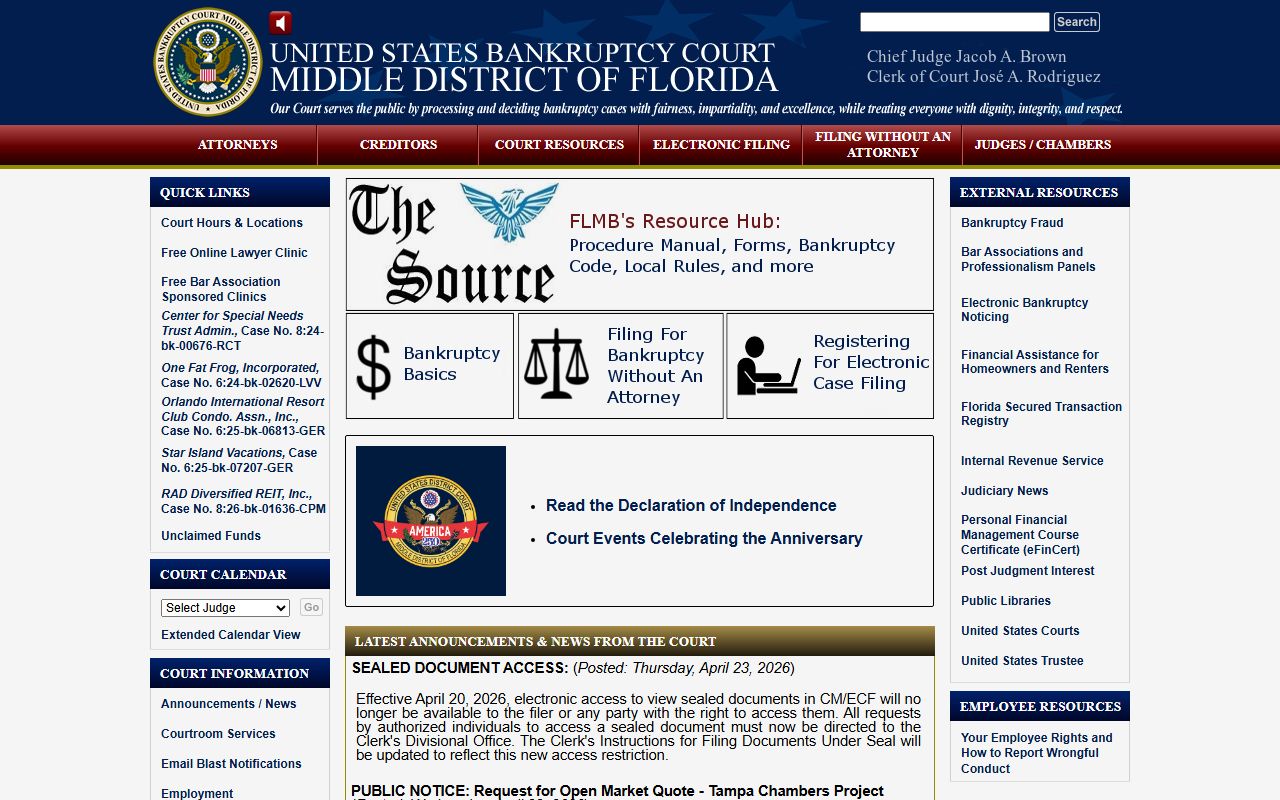
That site lists local divisional offices, judges, electronic filing access, fees, and chapter-specific filing instructions for federal bankruptcy.
Federal appeals from Marion County cases go to the U.S. Court of Appeals for the Eleventh Circuit. The Eleventh Circuit covers Florida, Georgia, and Alabama. Its rulings bind federal trial courts in Marion County. The federal inmate locator at bop.gov/inmateloc shows custody status for federal inmates from 1982 to present.
The third image is the Eleventh Circuit home page, the federal appellate court that reviews federal cases from Marion County.
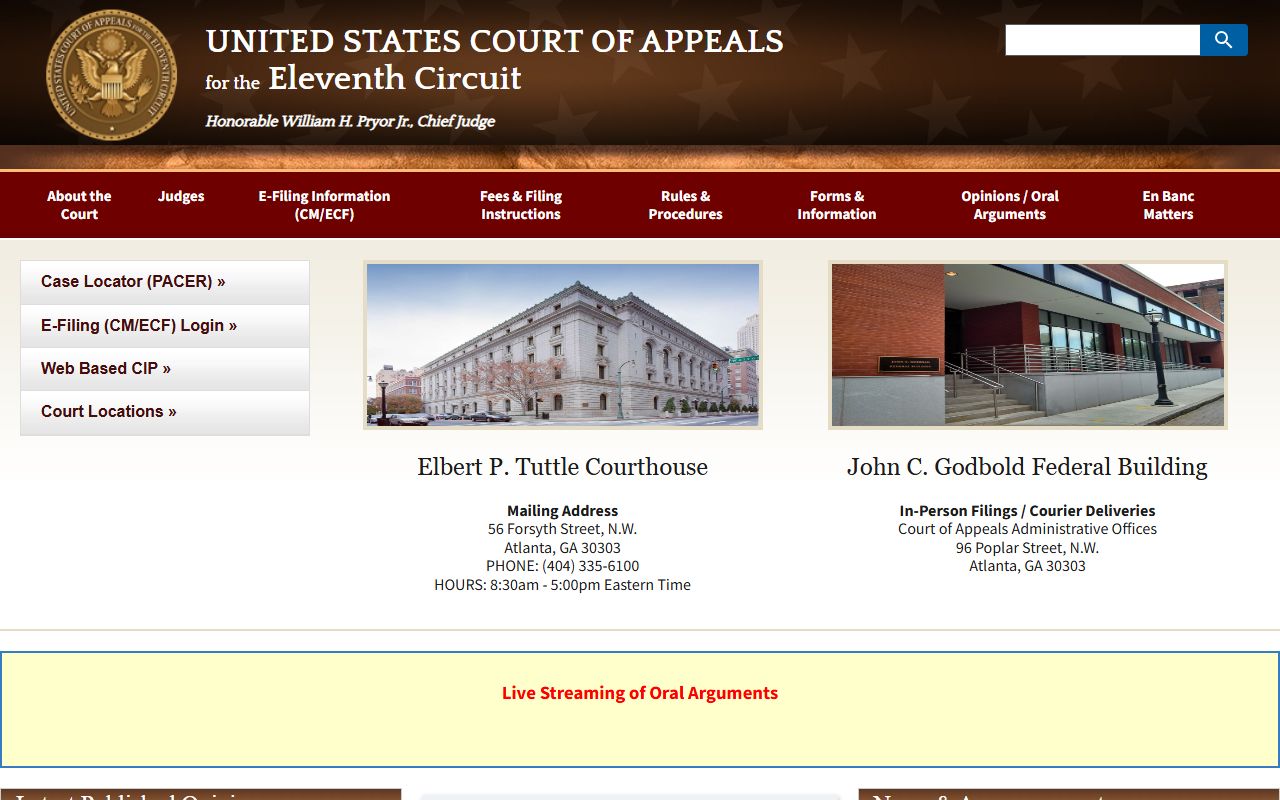
That page hosts the court's published opinions, oral argument calendar, local rules, and electronic case access tools.
Self-Help and Legal Aid for Circuit Court Filers
The Fifth Circuit lists a Self-Help Center and a Law Library among Marion County programs at the Judicial Center. The Clerk forms page covers Civil, Confidentiality, Criminal, Eviction, Family, Official Records, Restraining Orders and Injunctions, Small Claims, and Traffic Forms. Filers can print forms at no cost from the Clerk site or buy them at the counter for $0.15 per page. The Clerk staff can hand out forms and access records but cannot give legal advice.
Eligible criminal defendants in the Circuit Court are represented by the Fifth Judicial Circuit Public Defender. State Attorney victim services help crime victims with court contact and notification. Community Legal Services of Mid-Florida serves Marion County for civil legal aid in qualifying matters. The Florida Bar Lawyer Referral Service points people to private counsel for fee-based help. For domestic-violence injunctions, the Clerk's Restraining Orders and Injunctions forms work alongside Sheriff and local advocacy resources.
Pro se cautions matter here. Probate, family with children, criminal sealing or expunction, and eviction defense all carry deadlines. A missed deadline can cost a party the case. People who file in the Marion County Circuit Court without a lawyer should read the form instructions, check the OCRS docket after filing, and follow the judge's published procedures.
Brief History of the Marion County Courthouse
The Marion County Judicial Center is the fifth courthouse in the county's history. The old courthouse stood on the downtown public square. In the 1960s, leaders chose to build new rather than expand. The decision was controversial. Proposals to turn the old building into a museum did not succeed. In 1965, the old courthouse was demolished. The County Commission then traded the site to the City of Ocala so the square would stay public.
The current building is not a single-era structure. It combines the 1963 courthouse, the 1991 expansion, and the 2010 expansion. The 1991 work officially renamed the building the Marion County Judicial Center. A cornerstone from the 1906 Marion County Courthouse on the downtown square was set into the 1991 addition, keeping a physical link to the older era. The 2010 expansion added 146,520 square feet, five new courtrooms, a large jury assembly area, hearing rooms, and new office space. That growth let the Circuit Court absorb the rising caseload tied to Marion County's fast population growth.