
How to Find Recently Released Marion County Inmates
A Marion County released inmate search starts at the local jail roster. The Marion County Sheriff runs the jail and the public lookup. If the name is on the roster, the person is still in custody. If the name is gone, the person was released, transferred, or sent on to state or federal custody. The roster is a live list. It is not a full history of past bookings. A name that drops off is not the same as a confirmed release. Use the steps below in order.
- Open the Marion County jail roster at jail.marionso.com in a normal browser. Search by last name. Note the booking number if the person is still listed.
- If the person is no longer listed, call the Marion County Jail at 352-351-8077. Records staff can confirm release, transfer, or a data lag.
- Check the Florida Department of Corrections offender search if the case ended in a state prison sentence. The FDC site at pubapps.fdc.myflorida.com/OffenderSearch/inmateinfomenu.aspx has a separate Inmate Release list.
- Check the Federal Bureau of Prisons locator at bop.gov/inmateloc for federal custody, including released federal inmates back to 1982.
- Set up VINELink alerts at vinelink.com so future custody changes ping a phone or email.
The Marion County Sheriff Inmate Classification Unit is the team that handles release inside the jail. Per the Sheriff page on jail operations, classification staff set release dates, check release packets, run work-time credit, review records, and confirm warrants after hours. That is why a court order alone does not free a person. A booking can show as held even after a bond is paid, because warrant checks and packet review still have to clear. Knowing that helps explain why a name may sit on the Marion County jail roster for a few hours past the court ruling. For a Marion County inmate lookup tied to a current intake, see the inmate records page.
Setting Up Release Notifications via VINELink
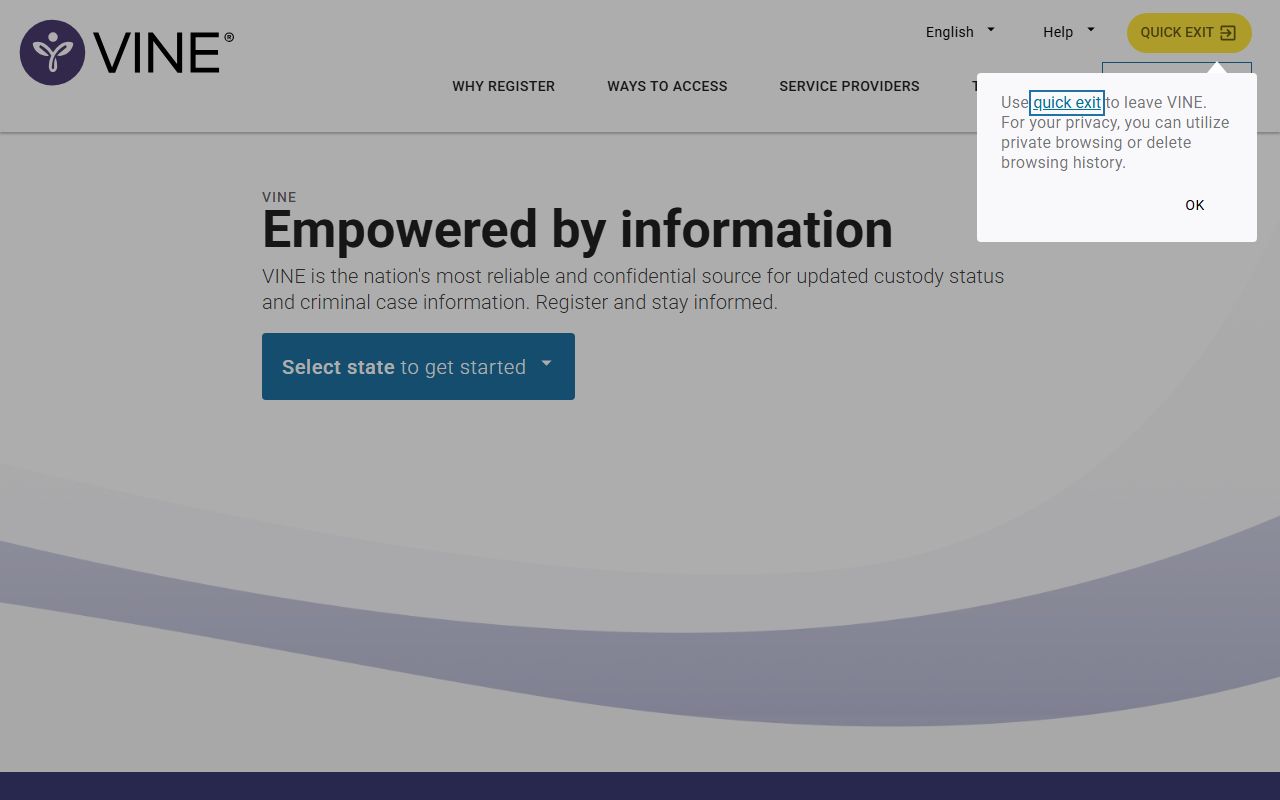
VINELink is the free public side of the VINE victim notification system. It pulls custody status from the agency that holds the person and sends an alert when that status changes. For Marion County released inmates, that agency is the Marion County Sheriff. For people moved to state prison, the alerts come from the Florida Department of Corrections. The screenshot below shows the VINELink home page used to start a Marion County release alert.
Alerts are free. Sign-up is anonymous on the user side. The inmate is not told that a notification was set. VINELink supports phone calls, text messages, and email. The system can ping on release, transfer, escape, court date, and bond posting where the agency feeds that data.
- Open vinelink.com. Pick Florida from the state list.
- Type the Marion County inmate name or known ID. Pick the matching record from the result list.
- Click the option to register for notifications. Add a phone, email, or both.
- Set a four-digit PIN. The PIN is used to stop the call when the alert rings.
- Confirm. The system will send a test ping and a future ping on each status change.
VINELink data can lag. Custody can change a few minutes or hours before the alert posts. For time-sensitive needs, such as a protection order check, pair VINELink with a direct Marion County jail roster check and a call to 352-351-8077. The Sheriff site at marionso.com/inmate-services lists the official inmate services and links to related custody tools.
Searching State Released Inmates: Florida Department of Corrections
The Florida Department of Corrections runs a public offender search at pubapps.fdc.myflorida.com/OffenderSearch/inmateinfomenu.aspx. The menu splits the search into Inmate Population, Inmate Release, Supervised Population, Absconder/Fugitive, and Escape lists. For a Marion County released inmate search at the state level, use the Inmate Release list. It covers people released from FDC custody, with release date, sentence length, and committing county. Marion County cases will list Marion as the committing county. The table below shows the public search fields.
| Field Label | Type | Required | Notes |
|---|---|---|---|
| DC Number | Text | No | Unique FDC offender ID. Best single match if known. |
| Last Name | Text | Name field needed | Most common entry point for a Marion County released inmate lookup. |
| First Name | Text | No | Add to narrow common last names. |
| Date of Birth Range | Date | No | Helps sort common names. Some menus accept a year range. |
| Race | Dropdown | No | Demographic filter on some FDC pages. |
| Sex | Dropdown | No | Demographic filter. |
| Custody Status / List | Menu | Yes | Pick Inmate Release, Supervised Population, Absconder/Fugitive, or Escape. |
An FDC profile holds a set of fields the Marion County user can rely on. Use the inventory below to read each result.
- Name and DC Number.
- Race, sex, date of birth, height, weight, and eye color.
- Committing county (Marion for local cases), sentence length, and offense list.
- Release date or projected release date.
- Current housing facility or community supervision office.
- Photo, scars, marks, and tattoos.
A Marion County state case starts in the Circuit Court and the Clerk routes the judgment to FDC. Probation and parole cases sit in the Supervised Population list, not the prison list. For sealed and expunged cases, the FDC record may be withheld. See the criminal records page for sealing and expunging notes.
Searching Federal Released Inmates: BOP Locator
The Federal Bureau of Prisons locator at bop.gov/inmateloc covers federal custody from 1982 forward, including released federal inmates. People charged in Marion County federal cases route through the U.S. District Court for the Middle District of Florida. Common federal counts include drug, firearm, fraud, and immigration charges. The BOP record shows release date, age, race, sex, and the location or status as of the last update. The table below lists the search fields.
| Field Label | Type | Required | Notes |
|---|---|---|---|
| BOP Register Number | Text | No | Exact federal inmate ID. Best single match if known. |
| DCDC Number | Text | No | Alternate ID option. |
| FBI Number | Text | No | Alternate ID option. |
| INS Number | Text | No | Alternate ID option for immigration cases. |
| First Name | Text | Name field needed | Use with last name for the name search path. |
| Middle Name | Text | No | Helps with common names. |
| Last Name | Text | Name field needed | Most common entry point. |
| Race | Dropdown | No | Demographic narrowing. |
| Sex | Dropdown | No | Demographic narrowing. |
| Age | Numeric | No | Narrow common names by age. |
| Year | Numeric | No | Year of custody or release. |
The locator does not show federal court charges, sentence detail, or detainers. For those, use PACER on the federal court file. A federal hold can also show as a detainer in the Marion County jail file, which delays release on a local charge. The warrant records page covers the FCIC and NCIC side of warrant holds.
Verifying Marion County Release In Person or By Phone
Some Marion County released inmate questions cannot be settled from a website. The jail roster can lag by minutes. VINELink can lag by hours. The two best ways to verify a release in real time are the phone and the in-person counter.
Call the Marion County Jail at 352-351-8077 for current custody, release, visitation, or welfare questions. Staff can confirm whether the person is still in custody, was transferred to FDC, was picked up on a detainer, or was released to the street. For a Marion County records request tied to the release, such as a booking report or a local background check, call the Sheriff Records Division at 352-351-6407 or email records@marionso.com. The Sheriff main line is 352-732-8181. The Records Division counter is at 692 NW 30th Avenue, Ocala. Walk-in services that need a fee stop at 4:15 p.m. each day.
The Sheriff FAQ at marionso.com/faq is a good first stop for routine release questions. The page below shows the FAQ as it appears live, with warrant, records, and public-record details.
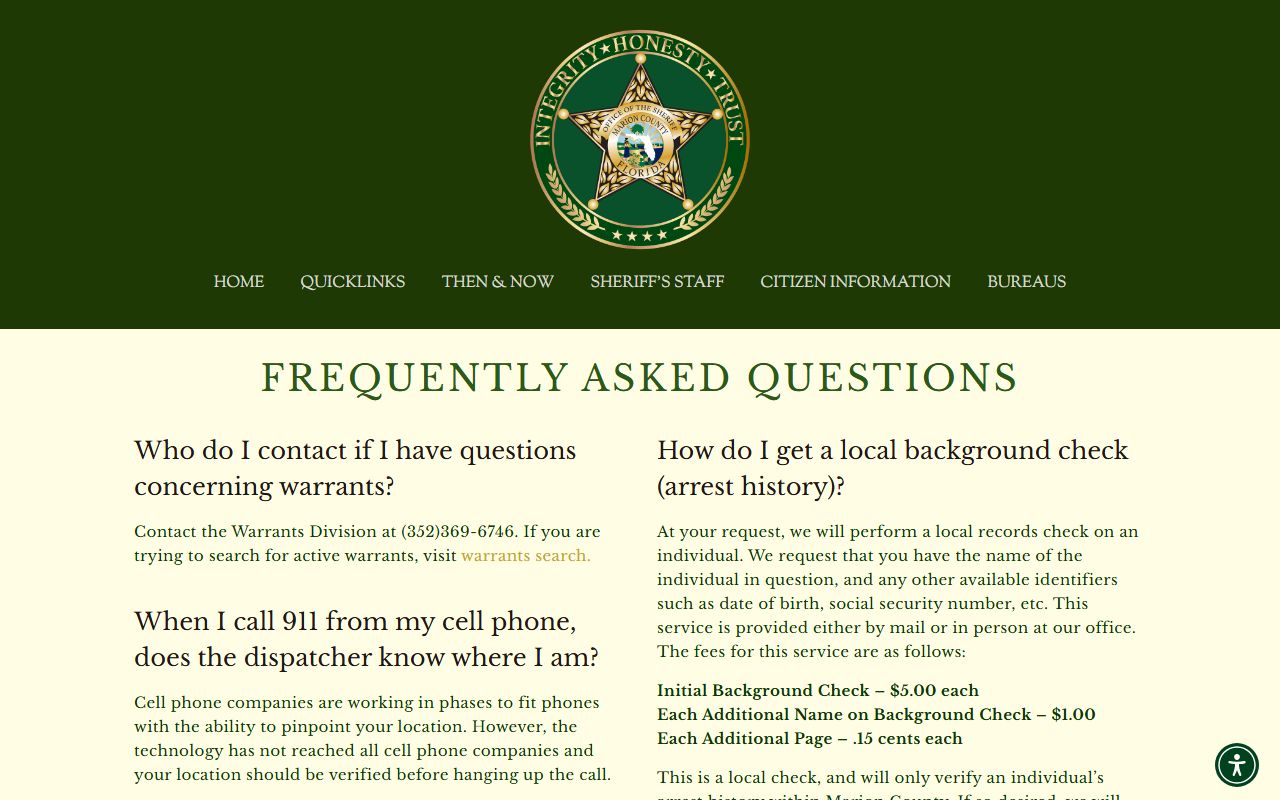
The Sheriff FAQ also notes that a local background check shows arrest history within Marion County only. A clean Marion County result does not rule out a record in another county or in the federal system. Pair the local arrest record with a court disposition through the Marion County Clerk at 352-671-5604. Clerk of the Circuit Court and Comptroller Gregory C. Harrell is the records custodian for court files. See court records for the Clerk path.
The Florida Sex Offender Registry: FDLE
For released inmates with sex offense convictions, the next public record is the Florida Department of Law Enforcement Sexual Offenders and Predators search at offender.fdle.state.fl.us/offender/Search.jsp. The FDLE registry covers people who must register under Florida law. Records carry a current address, photo, offense list, and predator or offender status. The Sheriff inmate services page at marionso.com/inmate-services links out to the same registry for local users.
The FDLE search fields are simple. Use the table below to plan a Marion County released sex-offender search.
| Field Label | Type | Required | Notes |
|---|---|---|---|
| Name | Text | No | Last and first name. Best match if a name is known. |
| City | Text | No | Enter Ocala, Belleview, Dunnellon, or other Marion County city. |
| ZIP Code | Text | No | Search by ZIP for a neighborhood scan. |
| Status | Dropdown | No | Offender, predator, deported, deceased, absconder. |
| Predator / Offender | Dropdown | No | Predator is a higher classification under Florida law. |
| Search | Button | n/a | FDLE warns positive identification requires fingerprint comparison. |
Each FDLE record holds a set of fields tied to public safety, not the full criminal history. The list below is what a Marion County user can expect on a registry hit.
- Full name and known aliases.
- Current registered address and county.
- Offense and statute, with offense date.
- Conviction date and court of conviction.
- Photo, race, sex, height, weight, and identifying marks.
FDLE notes on the registry page that the listing may not reflect the entire criminal history. The registry is a public safety tool, not a vetting tool, and Florida Statute 775.21 sets misuse warnings tied to the predator listing. For active warrants on a released sex offender, run the warrant check through the path on warrant records.
Parole and Probation Information in Florida
Florida is not a traditional parole state. The Legislature abolished parole for most offenses committed after October 1, 1983, so few people are paroled out of state prison today. The Florida Commission on Offender Review is the state body that hears the parole and conditional release cases that remain, sets terms for those releases, and runs clemency review for the Clemency Board. Most Marion County released inmates from a state prison sentence come out under community supervision, not parole. Community supervision is run by the Florida Department of Corrections through a regional probation office.
Florida Commission on Offender Review
State parole, conditional release, and clemency review
Tallahassee, FL
Florida Department of Corrections
Community supervision and probation
Regional probation offices statewide
Marion County released inmates on probation must report to the assigned probation officer, follow the conditions set by the sentencing judge, and submit to drug tests, search of person and residence, and electronic monitoring where ordered. A violation can lead to a warrant, a new arrest, and a probation hearing at the Circuit Court. The Marion County Sheriff Warrants Unit confirms warrants through FCIC and NCIC and can hold a released person on a violation warrant past any new bond. For the warrant path, call the Warrants Division at 352-369-6746.
Reentry Resources in Marion County
Reentry support for Marion County released inmates begins inside the jail. The Sheriff Programs Unit runs in-house programs that carry into release, and local nonprofits pick up housing, jobs, and treatment after release. The Sheriff jail visitation page also notes local taxi service and a SunTran bus stop within walking distance of the jail, so a released person can get a ride out the gate. SunTran schedule info is at 352-401-6999.
The list below names the in-jail programs the Sheriff Programs Unit lists on the official page. Many of these have community counterparts in Marion County that pick up after release.
- Alcoholics Anonymous and Narcotics Anonymous meetings.
- GED classes and literacy tutoring.
- Anger management programs.
- Men to Men, MITE, and WEST gender-specific programs.
- Religious services, Reformers Unanimous, and Christian 12 Step.
For released inmates in Marion County, a few common service paths help. CareerSource Citrus Levy Marion runs job training and placement. Goodwill of North Florida operates retail and job centers in Ocala. The Salvation Army of Marion County offers shelter and food help. Interfaith Emergency Services in Ocala helps with emergency housing, rent, and utilities. Florida Department of Health in Marion County runs treatment and behavioral health referrals. A released person who needs a state ID can go to the Florida Department of Highway Safety and Motor Vehicles in Ocala. Each agency has its own intake. Call ahead before a visit.
Civil Rights Restoration After Release in Florida
Florida bars people with felony convictions from a set of civil rights. Some come back after sentence completion. Others come back only through the state Clemency Board. The rules changed when Florida voters passed Amendment 4 in 2018. The current path is set by Amendment 4 and the laws that followed it.
Voting rights for most Marion County released inmates with a felony conviction are restored once the person completes the full sentence, including any term of probation or parole and any legal financial obligations ordered as part of the sentence. Amendment 4 carved out two groups. People with a felony murder conviction and people with a felony sexual offense conviction must still apply to the state Clemency Board to vote. To check status or register, use the Florida Division of Elections and the Marion County Supervisor of Elections.
Firearm rights do not come back on their own. A Florida felony conviction blocks firearm possession under state and federal law. To restore firearm rights, a released person must apply for clemency through the Florida Commission on Offender Review, which staffs the Clemency Board. The Board can grant a full pardon, a pardon without firearm rights, or restoration of civil rights with or without firearm authority. Each case is reviewed on the facts.
Other rights tied to a conviction follow the same path. The right to hold public office and the right to serve on a jury are restored only through clemency. Sealing or expunging a record is a separate path under Florida Statutes 943.0585 and 943.059. That path starts with a Certificate of Eligibility from FDLE and a petition filed at the court that handled the case. The Marion County Clerk's sealing and expunging page lists the steps. For more on records that survive a release, see public records and the FAQ page.