
About Marion County Probate
Probate is the court process for sorting out what a person owned at death and moving those assets to the right heirs or beneficiaries. In Florida, probate is heard in the Probate Division of the Circuit Court. Marion County sits in the Fifth Judicial Circuit, along with Citrus, Hernando, Lake, and Sumter. Files are kept by the Marion County Clerk of Court and Comptroller in Ocala. The Clerk indexes the case, holds the original will, and tracks every order, inventory, and accounting in the file.
Florida has more than one path through probate. The path depends on what the decedent owned, whether there is a will, and how much time has passed. Formal administration is the full-length court case used for larger estates and contested matters. Summary administration is a shorter track for smaller estates or older deaths. Disposition without administration moves a small amount of personal property without opening a full estate. Ancillary administration is used when the decedent lived out of state but owned property in Marion County. Each path has its own filing, notice, and fee rules.
The Clerk site gives a plain-English overview at the Marion County probate page. That page is the right first stop for any Marion County probate records question.
Types of Marion County Probate Cases
The Probate Division hears more than just decedent estates. The Clerk codes these case types with CP for probate and GA for guardianship in the Online Court Records Search. A name lookup may hit either code, so most users check both. The main case families filed in Marion County are listed below.
- Decedent estates with a will, called testate cases. The will is the road map, and a personal representative is named by the testator.
- Decedent estates with no will, called intestate cases. Florida intestacy law sets the shares of the spouse and the heirs.
- Summary administration for small estates or older deaths, plus disposition without administration for narrow asset transfers.
- Guardianship of the person, the property, or both. These cases protect a minor or an adult who cannot manage day-to-day choices.
- Will deposits, trust filings, ancillary estates for out-of-state decedents, and Baker Act or mental health commitments that the Probate Division hears.
Some files mix more than one type. A decedent estate may also need a guardian for a minor heir. A guardianship case may end with a probate file when the ward dies. The OCRS search lets the user click both Probate/Guardianship and Guardianship as court-type filters at the same time.
How to Search Marion County Probate Records
The free path is the Marion County OCRS portal hosted by Civitek for the Clerk. OCRS lists circuit and county case files for both open and closed matters. The Clerk recommends OCRS as the starting point for any Marion County probate records search.
Before opening the search form, gather a last name, a first name, and a filing year if possible. For probate the last name is the decedent or the ward. For guardianship the last name is the ward, not the guardian. Have a clean browser and a working internet line ready.
- Open the Marion County OCRS county page and click the Public lane. No login is needed for public access.
- Read the disclaimer and click I Agree. The portal loads under Florida AOSC 16-107 access rules.
- Pick the Person Search tab. Type a Last Name and a First Name/MI, or use the Business Name field for a corporate fiduciary.
- Tick the Probate/Guardianship (CP) box and the Guardianship (GA) box in the Court Type list. Add a filing date range if known.
- Pass the Cloudflare Turnstile robot check, then click Search. Click any case row to open the docket.
The Clerk site gives the same path through its probate guidance page. The image below is the Clerk page that explains probate, will deposit, and certified-copy fees. The page is the official source for local procedure.
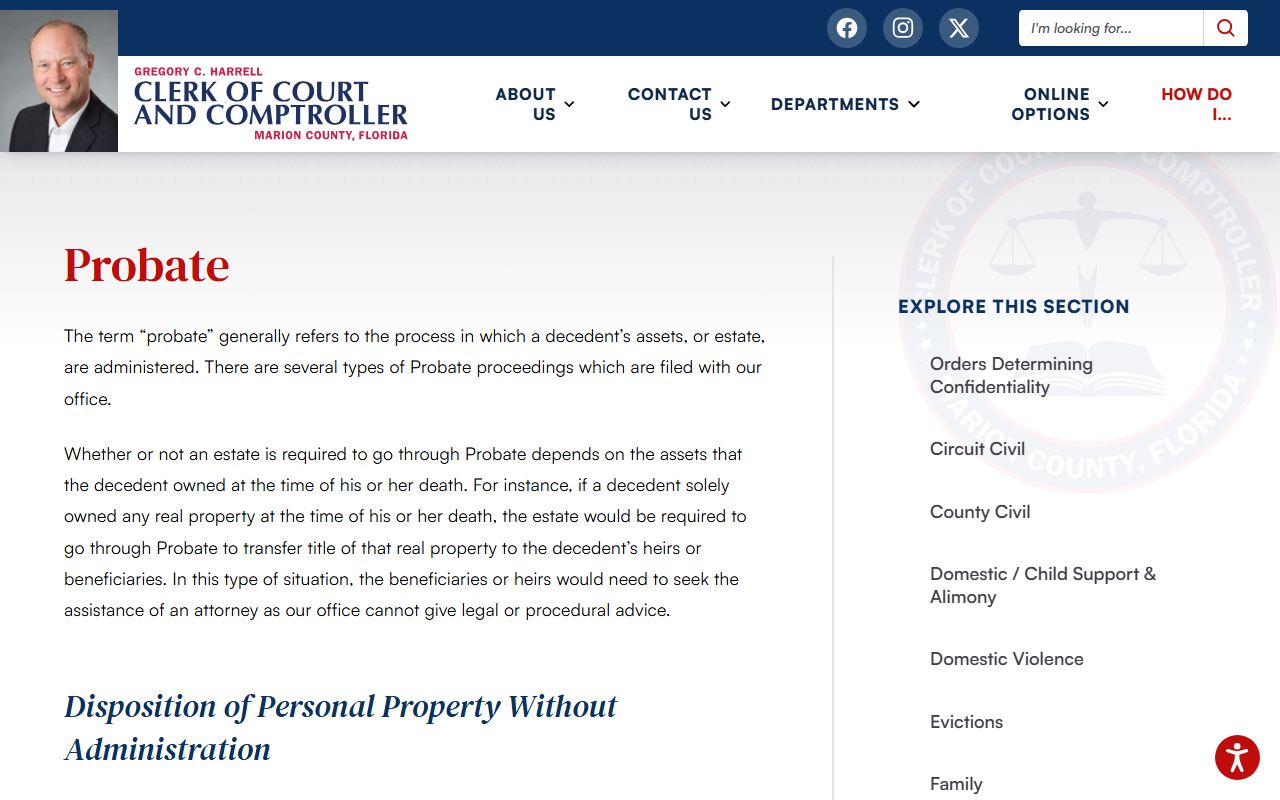
That guidance ties to the case file in OCRS. The Clerk page covers will deposit timing, the disposition without administration checklist, and the cost to certify a will. A user who has read the Clerk page first will know which OCRS court-type filter to pick.
What Marion County Probate Records Show
A probate case file is not one document. The Clerk logs each filing as a docket entry. Some entries link to a clickable image; some sit behind the Clerk counter as paper. The table below lists the core fields seen on a Marion County probate records search result and what each one means.
| Field | What It Shows |
|---|---|
| Case Number | The Clerk-assigned ID. For probate it carries the CP court-type code, the year, and a sequence number. |
| Decedent Name | The deceased person whose estate is being probated. For guardianship cases the ward name is in this field. |
| Personal Representative | The person or entity named in the letters of administration to settle the estate. Sometimes called an executor or PR. |
| Filing Date | The day the petition was filed with the Clerk. This is the From date on OCRS. |
| Case Type | One of formal administration, summary administration, disposition without administration, guardianship, will deposit, or ancillary. |
| Petitioner / Attorney | The party asking the court for relief and the law firm of record. Pro se filers show with no firm. |
| Assets and Inventory | A list of estate assets filed with the inventory. Bank accounts, real property, vehicles, and accounts. Some detail may be sealed. |
| Creditor Claims | Statements of claim filed by creditors after the notice to creditors runs. Each claim has a date and an amount. |
| Orders and Letters | Court orders such as the order admitting will, letters of administration, orders on objection, and the order of discharge. |
| Closing Date | The date the court enters a final order or order of discharge. Marks the close of the case. |
Some fields, like a Social Security number or a bank account number, are redacted under Florida Rule 2.420 even when the rest of the file is open. The Clerk will not show those on the OCRS public lane.
Marion County Probate Court Process
The path through Probate Court in Marion County is set by Florida law, but the local Clerk handles the day-to-day filings. A typical formal estate moves through a fixed set of steps. The exact order may shift if there is a contest, a missing heir, or a real property issue.
- The custodian of the will files the original will with the Clerk within ten days of learning of the death. A petition for administration is filed soon after.
- The court enters an order admitting the will and signs letters of administration that name the personal representative.
- The PR sends notice to known creditors and publishes a notice to creditors in a Marion County paper of record.
- The PR files an inventory of estate assets, pays valid claims, sells assets if needed, and files tax returns. Interim accountings may be due.
- The PR files a petition for discharge with a final accounting and a plan of distribution. The court enters the order of discharge and closes the case.
The Clerk warns that beneficiaries and heirs should get a lawyer. The Clerk staff can not give legal advice or fill out probate forms. Marion County also has a local rule for probate and guardianship: proposed orders must be sent through the Florida E-portal in Word format only, and the attorney has to mail a copy to any pro se party and file a certificate of compliance.
Will Deposit and Disposition Without Administration
Two narrow tracks come up often at the Clerk counter. Both are explained on the Clerk probate page, and both are common reasons a Marion County family first walks into the Judicial Center.
Will deposit is the simple act of filing the original Last Will and Testament after the testator has died. Florida law at Fla. Stat. § 732.901 says the custodian must deposit the original will with the Clerk having venue within ten days of learning of the death. The custodian must also supply the date of death or the Social Security number of the testator. Marion County also asks for a death certificate with the original will. There is no filing fee to deposit a will. The depositor gets a Receipt for Deposit of Will with a file number, a filing date, and the Clerk seal.
Disposition of Personal Property Without Administration is a way to move a small set of personal assets without opening a full estate. The Clerk page lists Florida Statutes 735.301 through 735.304 as the law that sets eligibility. This path can not be used when real property is involved. The opening packet usually includes an affidavit or letter, the original will if any, a death certificate, a funeral home statement showing who paid the bill, signed and notarized consents from heirs, and copies of bank or insurance documents. A filing fee is due at the petition. If the judge signs the order, the order directs the holding institution to release the assets to the party in the petition. A certified copy of the order is often required by the bank or insurer.
Probate Filing Fees and Certified Copy Costs
Searching OCRS is free. Fees kick in when the user files a petition, asks for a certified copy of a will, or buys an e-certified order. The full Florida fee structure sits in Fla. Stat. § 28.24. The Marion County Clerk publishes a local Schedule of Service Charges PDF for the exact local amounts.
| Service | Fee | Notes |
|---|---|---|
| OCRS probate search | Free | Public lane, no login needed. |
| Will deposit | No charge | No filing fee to deposit an original will under § 732.901. |
| Certified will copy | $1.00 per page plus $2.00 certification | Listed on the Clerk probate page. Each certified copy gets a Clerk stamp and seal. |
| Certified copy of order | $1.00 per page plus $2.00 certification | Standard Florida certified-copy rate. Banks often ask for the order for payment of funds. |
| Plain paper copy | $0.15 per page | Standard county rate for non-certified copies. |
| Probate filing fee | Set by Fla. Stat. § 28.24 | Amount depends on the petition type, estate size, and procedure. Check the Clerk Schedule of Service Charges. |
| Clerical research | $20 first hour minimum (after 15 minutes), then $5 per quarter hour | Used when staff time is needed for an extensive lookup. |
Mail requests should include a check, a self-addressed stamped envelope, and a case number or party name. The Clerk will not start work until the fee has cleared. For broader fee detail see the court records page.
Guardianship and Conservatorship Records in Marion County
Florida uses the word guardianship for what some states call conservatorship. The Probate Division hears both guardianship of the person and guardianship of the property. A guardian of the person makes decisions about housing, medical care, and day-to-day life for a ward. A guardian of the property handles bank accounts, real estate, and benefits checks. The court can name one guardian for both roles or split them between two people.
Guardianship cases are coded GA in OCRS. A name lookup by ward returns the case, the guardian, and the docket. Some guardianship detail is restricted from the public view, in part because the file holds medical and financial records. Annual guardian plans and accountings are filed with the Clerk and are reviewed by the court. The judge can order a guardianship to be reviewed, modified, or ended if the ward no longer needs the help.
Conservatorship in Florida is a narrow probate track used for absentees, such as a service member missing in action. It is not the same as guardianship and is filed under a different chapter of the Florida Probate Code.
Adoption and Dependency Records
Two related case types are kept out of the standard public lane. Both are heard in circuit court, but neither shows up in the open OCRS results.
Adoption records are confidential under Fla. Stat. § 63.162. The court file, the report of the investigator, and the Clerk index are all sealed. A party with a court order or a statutory ground can ask to inspect the file. The image below is the official Senate page for the adoption-record confidentiality statute. The text on that page is the law that bars the Clerk from showing an adoption file on the public lane.
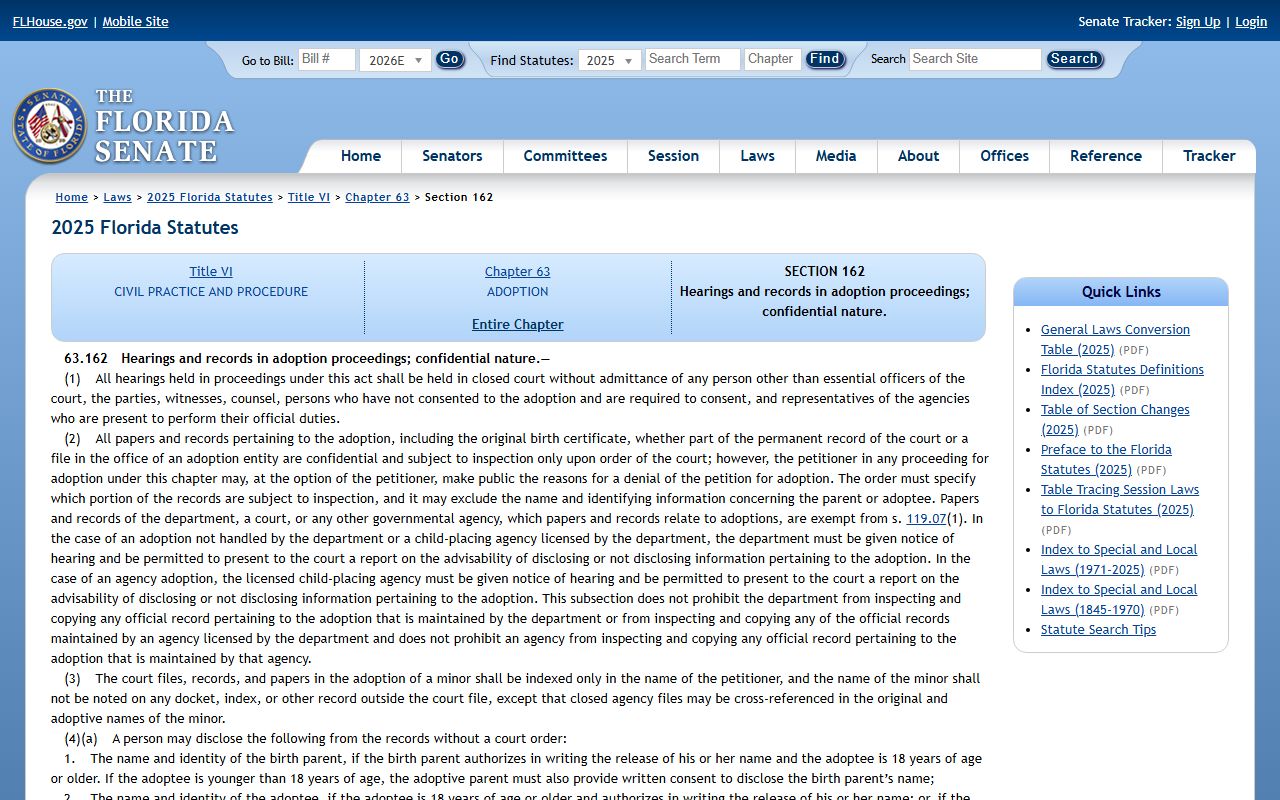
Adoption is not technically a probate matter, but the Marion Clerk handles the file under the same Clerk umbrella, and the family law division at the Judicial Center is where the case is heard.
Dependency, shelter, abuse, and neglect records are confidential under Fla. Stat. § 39.0132. These files are kept in the juvenile division, not the Probate Division, but they often touch probate when a minor heir needs a guardian. The next image is the Senate page for the dependency-record confidentiality statute.
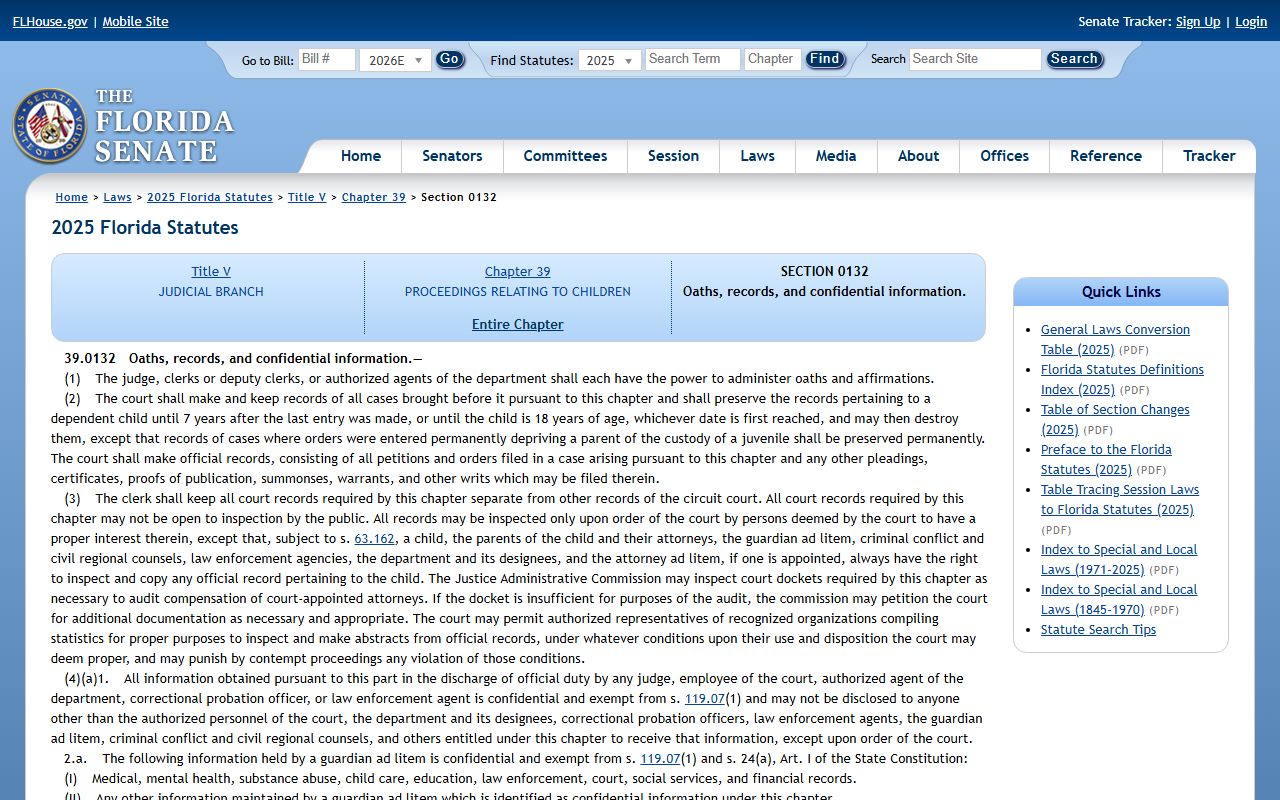
The dependency statute is the reason the Clerk will not pull a shelter or dependency file at the counter without proper standing. A party in the case, the parent, the child, and certain agencies can see the file. Most other users need a court order.
Probate Glossary
Probate uses a thick stack of legal words. The list below covers the terms most likely to come up in a Marion County probate records search or at the Clerk counter.
- Testator
- The person who made the will. A testator must have signed the will under Florida formalities for the will to be valid.
- Executor
- The person named in a will to carry out its terms. Florida law calls this role the personal representative.
- Personal Representative
- The court-named fiduciary who settles the estate, called a PR. The court signs letters of administration that prove the role.
- Intestate
- Dying without a valid will. The Florida intestacy statute sets the shares of the spouse and the other heirs.
- Codicil
- A short add-on or change to an existing will. A codicil must meet the same signing rules as the will.
- Guardian Ad Litem
- A person named by the court to represent a minor or an incapacitated party in one case. Often called a GAL.
- Conservator
- In Florida, a narrow Probate Code term for the person named to handle the property of an absentee. Other states use the word more broadly.
- Probate
- The court process for proving the will, paying the debts, and moving the assets of a decedent to the heirs or beneficiaries.
- Letters Testamentary
- The court order that names a personal representative when there is a will. Banks ask for letters before they release estate funds.
Marion County Probate Division Contact
The Probate Division sits inside the Marion County Judicial Center in downtown Ocala. The Clerk has a probate counter on site and a probate phone line for case questions. The court address and phone are listed in the card below.
Probate Division, Fifth Judicial Circuit
Marion County Judicial Center
110 NW First Avenue
Ocala, FL 34475
352-671-5604
Monday to Friday, 8:00 a.m. to 5:00 p.m.
Greg Harrell is the elected Clerk of Court and Comptroller and runs the office that maintains probate files. For broader office detail see the Clerk of the Circuit Court and Comptroller page. The Fifth Judicial Circuit Marion County page at circuit5.org lists the probate judges on rotation, the courthouse history, and the proposed-order rule for probate filings.
Public Access to Probate Records
Florida has one of the broadest public-records laws in the country. Probate files sit under the same Chapter 119 access rules as the rest of the court system. The Clerk treats most probate filings as open to the public, except where a statute, a court order, or Florida Rule 2.420 says otherwise.
The general public-records statute is Fla. Stat. § 119.011. Inspection, copying, and the duty to cite an exemption sit in Fla. Stat. § 119.07. Court-file protections, including the rules for sensitive numbers and minor-name redactions, are in Fla. Stat. § 119.0714. The Clerk redacts Social Security numbers, bank account numbers, victim names, and other sensitive data from filings that do show in the public view. Some guardianship medical and financial records, mental health commitments, adoption files, and dependency records stay confidential. For a broader view of what is and is not open, see the public records page.
Anyone can ask the court to seal or redact a record under Rule 2.420. A judge can also order a probate file sealed in part if a statute, a court rule, or a strong privacy interest applies. For more on access law and how to request a court file, see the court records page. Common questions about probate, certified copies, and search filters are answered on the FAQ page. For marriage and divorce records, which are filed in the same Clerk system but coded DR, see the marriage and divorce records page.
Note: The Clerk staff can not give legal advice or fill out probate forms. A user with a contested estate, a missing heir, or a real property issue should hire a Florida probate lawyer.