
How to Search Marion County Criminal Records
Marion County criminal records sit in three buckets. Arrest reports come from the Marion County Sheriff. Court cases come from the Marion County Clerk through OCRS. Statewide history comes from FDLE.
- Open the Marion County OCRS portal. Click Public, agree to the disclaimer, and use the Person Search tab. Enter last name and first name, then filter Court Type to Felony (CF), Misdemeanor (MM), or Criminal Traffic (CT).
- Run a Marion County Sheriff records request through the MCSO Records Division. Case report copies are $0.15 per page. A local Marion County background check is $5 for the first name plus $1 per added name.
- Pull a statewide criminal history from FDLE. Submit a name-based check online, or send fingerprints for a more complete result.
- Cross-check the arrest with a court disposition. Open the Marion County OCRS case file to see plea, sentence, and current status.
An MCSO local check covers Marion County case files only. FDLE pulls every reporting agency in the state. National results go through FDLE to the FBI.
Types of Marion County Criminal Records
Marion County criminal records break out by who creates them and when. Each type shows a different stage of a case. Knowing the type points you to the right office.
- Arrest reports. Created by the Sheriff or a city police agency at the time of arrest. Shows the booking, charges as filed, and the narrative.
- Jail booking records. Made when a person is booked into the Marion County Jail at 3290 NW 10th St., Ocala. Includes identity, booking photo, and initial charges.
- Criminal court case files. Held by the Clerk. Felonies are CF in circuit court. Misdemeanors are MM in county court. Criminal traffic is CT.
- FDLE statewide criminal history. A compiled record of every Florida reporting agency. Used for background checks and as the source for sealing or expunction.
- Specialty court records. Drug court files in Circuit 5. Some entries are confidential while a participant is in the program.
For motions, hearings, and final judgments, see Marion County court records.
What Marion County Criminal Records Show
A criminal record is a set of data fields, not one long document. A Sheriff arrest report leans toward booking data. A Clerk case file leans toward court action. Below is a sample inventory of the fields a Marion County criminal record commonly shows.
| Field | What It Shows |
|---|---|
| Booking Number | Unique number assigned at jail intake. |
| Arrest Date | Date the person was taken into custody. |
| Arresting Agency | MCSO, Ocala Police, Belleview, Dunnellon, FHP, FDLE, or a federal unit. |
| Charges | Statute number and short title of each charge. |
| Court Case Number | Clerk case number once charges are filed (CF, MM, CT). |
| Court Type | Circuit (felony) or county (misdemeanor or criminal traffic). |
| Disposition | Outcome: guilty, not guilty, dismissed, nolle prosse, or withhold of adjudication. |
| Sentence | Jail, prison, probation, fines, costs, restitution. |
| Booking Photo | Mugshot held by the Sheriff at the jail intake stage. |
| Hearing Dates | Arraignment, status, plea, trial, sentencing, and review dates. |
Not every field is public on every record. Victim names, juvenile identifiers, and sealed entries are redacted under Chapter 119 and Rule 2.420.
Charges vs. Convictions
An arrest is not a conviction. A charge is what the State accuses you of. A conviction is what a judge or jury finds after a plea or trial. The table below sets them apart.
| Charge | Conviction | |
|---|---|---|
| Definition | Formal accusation filed by the State. | Adjudication that a person is guilty. |
| When Assigned | At booking or when the State files an information or indictment. | After a plea of guilty or no contest, or a guilty verdict. |
| What Appears in the Record | Statute, charge title, count number, and court type code. | Disposition, sentence, fines, probation terms, restitution. |
| Public Access | Public unless sealed or confidential. | Public unless sealed, expunged, or shielded by statute. |
| Can It Be Sealed? | Yes if the charge ended in dismissal, nolle prosse, or withhold without prior disqualifying history. | Generally no. A formal conviction usually blocks sealing. |
Florida also has a third option called withhold of adjudication. The judge accepts a plea but does not formally adjudicate guilt. Eligibility for sealing often turns on whether the case ended in a withhold.
Marion County Felony vs Misdemeanor Court Routing
Felonies go to circuit court. Misdemeanors stay in county court. That split shapes which file you pull and which judge handles the case.
Felony cases are filed in the Fifth Judicial Circuit and coded CF. The Marion County Judicial Center at 110 NW First Avenue in Ocala is the main felony venue. Documents include an information or grand jury indictment, arrest affidavit, bond orders, plea forms, motions, and sentencing paperwork. For more on the trial-level court see Marion County Circuit Court.
Misdemeanor cases stay in county court and are coded MM. Criminal traffic cases such as DUI use the CT code. The Marion County Court page covers the county-level bench. The Clerk runs case files for both court levels and posts them in OCRS.
Sealed vs Expunged Records
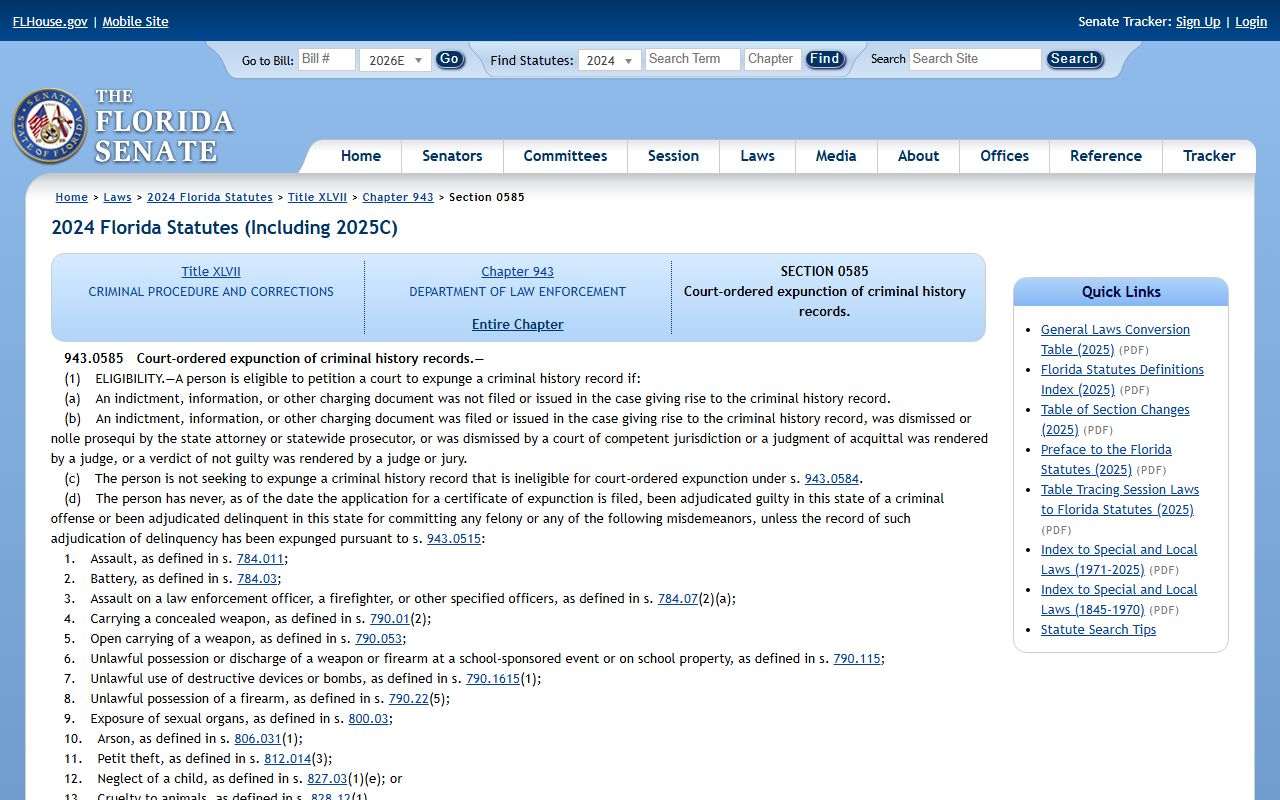
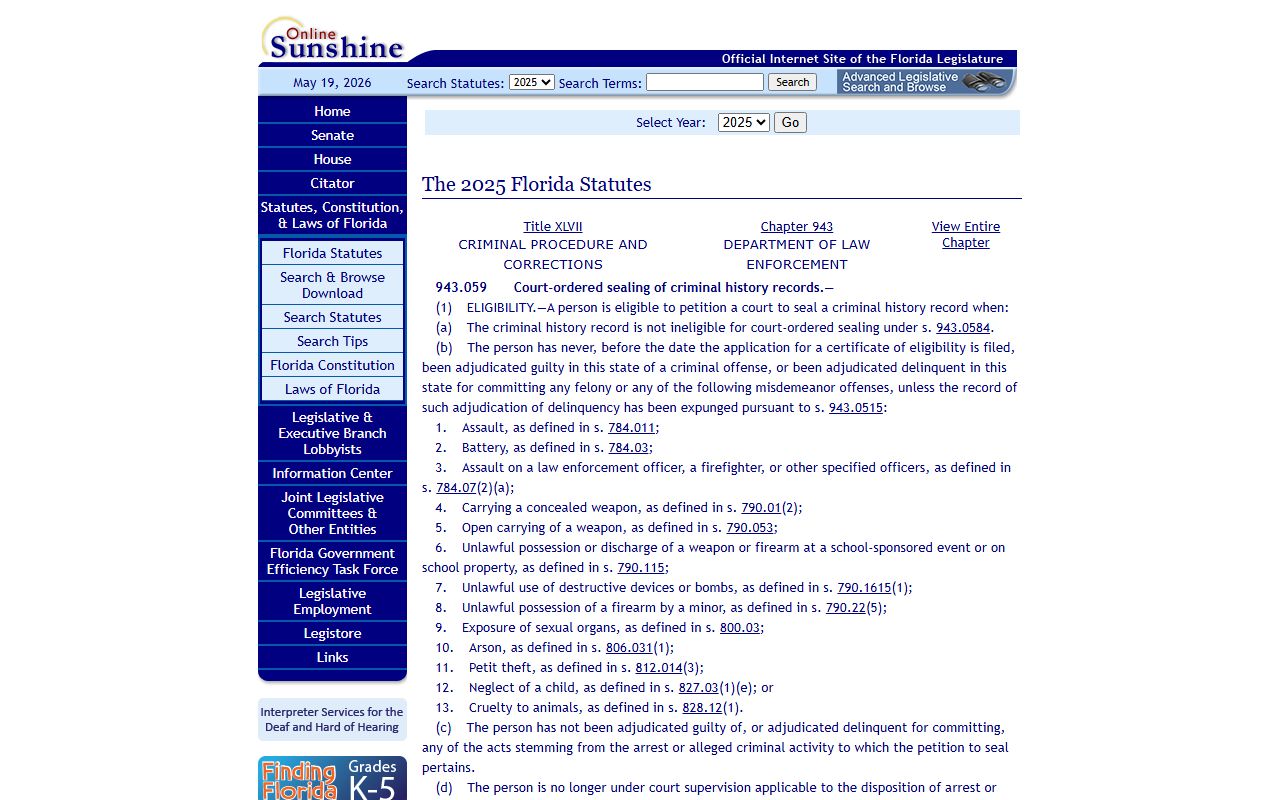
Sealed and expunged are not the same. Both keep a record out of public view. The level of protection is different, and so is the law. Florida treats sealing under one statute and expunction under another.
| Sealed | Expunged | |
|---|---|---|
| Definition | Record made confidential from general public view. The file still exists. | Record physically destroyed or removed. Treated as if it never happened for most uses. |
| Eligibility | Cases that did not end in adjudication of guilt, with no prior sealing or expunction, and no disqualifying offense. | Cases that ended in dismissal, nolle prosse, no information, or acquittal, with no prior sealing or expunction. |
| Who Can Still See It | Law enforcement, courts, criminal justice agencies, certain licensing and sensitive-position employers. | Very limited access. A court order is needed for most disclosure. Same list of statutory exceptions applies. |
| FDLE Certificate Required | Yes. The Certificate of Eligibility must be issued before the petition is filed. | Yes. FDLE certificate is required first. |
| Governing Statute | Fla. Stat. 943.059 | Fla. Stat. 943.0585 |
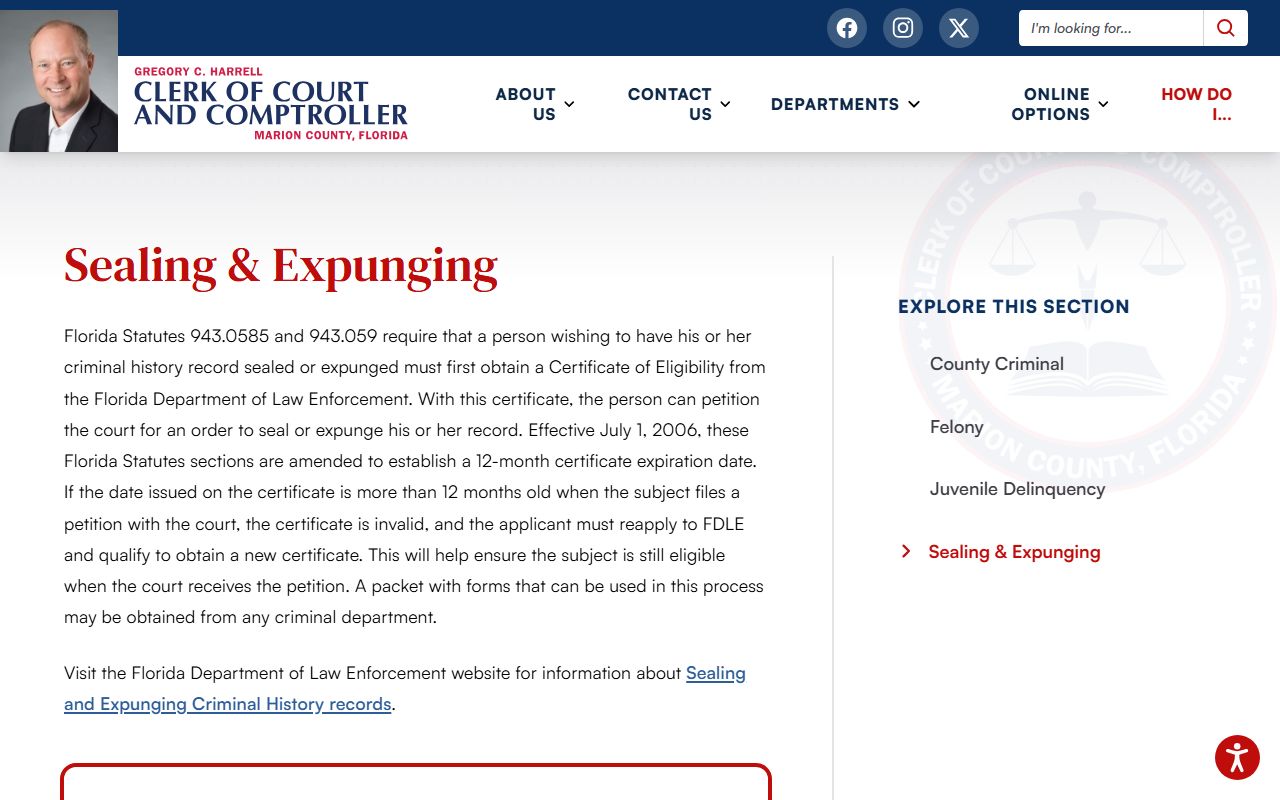
Sealed and expunged records are still disclosable to certain agencies. The Marion County Clerk page on sealing and expunging spells out the exception list, which covers licensing boards, bar admission, law enforcement hiring, and jobs with children.
How to Seal or Expunge a Marion County Criminal Record
The sealing and expunction process runs through two offices. FDLE issues the eligibility certificate. The Marion County Clerk handles the court filing. Below is the standard order.
- Confirm eligibility. Pull your FDLE record and check for any prior conviction, prior seal, or disqualifying offense.
- Apply to FDLE for a Certificate of Eligibility. Send the packet with certified disposition, fingerprints, and the fee.
- Prepare the court petition. Include the petition, sworn affidavit, FDLE certificate, and proposed order. Cite Fla. Stat. 943.0585 for expunction or 943.059 for sealing.
- File with the Marion County Clerk in the court that handled the original case. Serve the State Attorney and the arresting agency.
- Attend the hearing if the judge sets one. The State Attorney may object.
- The Clerk sends the signed order to the Sheriff, FDLE, and any other agency holding the record.
A missing FDLE certificate, a pending charge, or a service gap will get a petition denied. Self-help resources are listed on the Marion County public records page.
Juvenile Criminal Records
Florida Statute 985.04 makes most juvenile justice records confidential. The Marion Clerk maintains juvenile cases but does not post them in the OCRS public search the way adult cases appear. Access is limited to the child, parents or guardians, the child's attorney, law enforcement, and persons authorized by court order.
Dependency files are restricted under Fla. Stat. 39.0132. Adoption files are confidential under Fla. Stat. 63.162. A court order is usually required to inspect them.
Sex Offender Registry
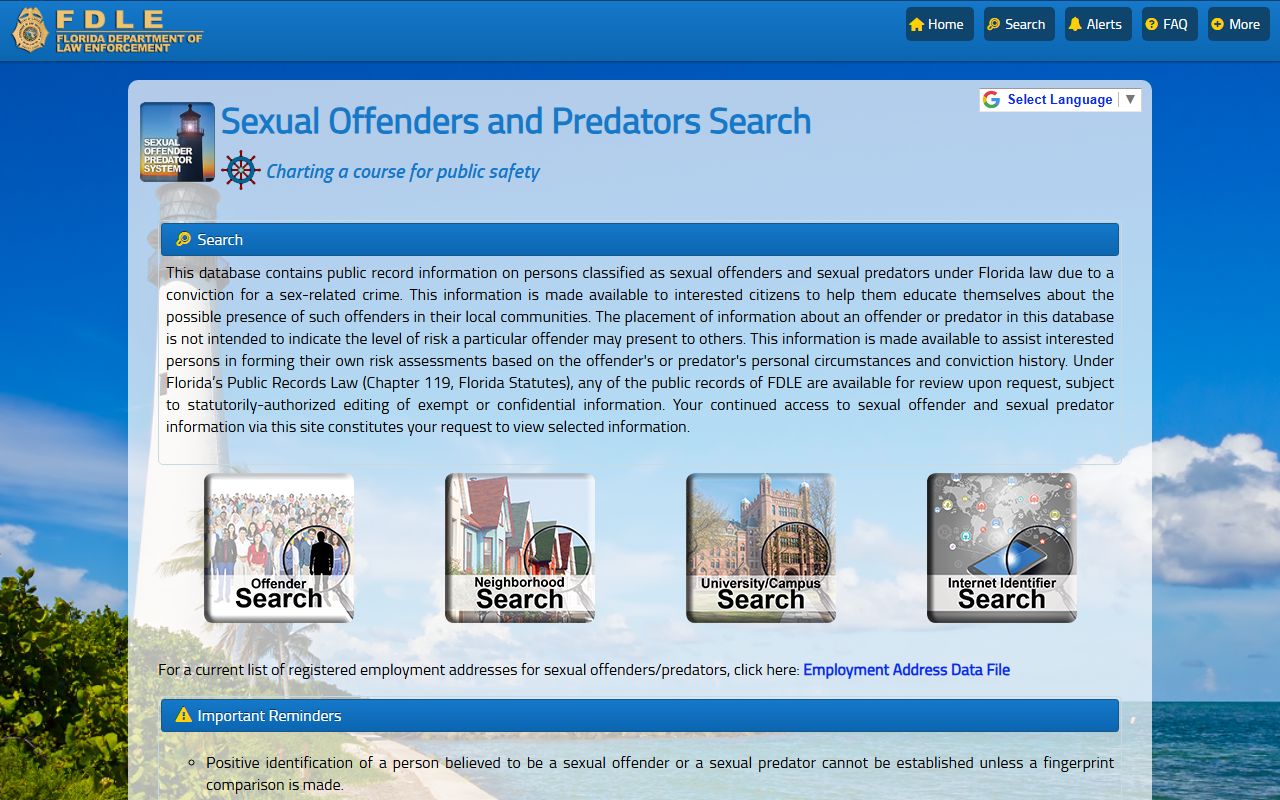
Florida maintains a public registry of sex offenders and predators through FDLE. The registry lists name, photo, address, offense, and registration status. It is searchable by name, address radius, and county.
To look up Marion County registrants, use the FDLE Sexual Offender and Predator Search. The page applies a misuse warning under Fla. Stat. 775.21(10)(d). Information from the registry cannot be used to harass any person listed.
Background Checks and Criminal History
A Marion County background check has three tiers. A local check at the Sheriff covers Marion case files only. A statewide check at FDLE covers every Florida reporting agency. A national check goes through FDLE's channel to the FBI for fingerprint-based results.
The MCSO Records Division charges $5 for the first name and $1 for each added name. The Sheriff FAQ notes that an arrest hit should be paired with the disposition pulled from the Clerk's record. FCIC and NCIC criminal history checks are run through FDLE.
Important: This site is not a consumer reporting agency under the Fair Credit Reporting Act. Data here may not be used for credit, employment, tenant screening, or any FCRA-covered purpose.
Restricted and Confidential Criminal Records
Not every Marion County criminal record is public. Florida law and court rules pull some files out of open access.
- Sealed and expunged records under Fla. Stat. 943.0585 and 943.059.
- Juvenile justice records under Fla. Stat. 985.04.
- Active criminal intelligence and investigative information under Chapter 119 exemptions.
- Victim identity in sexual offense and child abuse cases.
- Personal identifiers and protected addresses under Fla. Stat. 119.071.
Mental health records are protected under Fla. Stat. 394.4615. A member of the public who wants access to a sealed court file needs a court order.
Marion County Sheriff Records Division Fees and Contact
Sheriff Billy Woods leads the Marion County Sheriff's Office. The Records Division is the front door for arrest reports, local background checks, fingerprinting, felon registration, ticket copies, and report retention.
The Records Division is at 692 NW 30th Avenue, Ocala, FL 34475. Mailing address is PO Box 1987, Ocala, FL 34478. Records hours are Monday and Tuesday 8 a.m. to 5 p.m., Wednesday 8 a.m. to 3:30 p.m., and Thursday and Friday 8 a.m. to 5 p.m. Services that take payment cut off at 4:15 p.m. The main phone is 352-732-8181 and Records questions go to 352-351-6407 or records@marionso.com.
Case report copies are $0.15 per page. Certified copies are $1.00 each. Clerical research over 15 minutes is $20 for the first hour, then $5 per quarter hour. Local fingerprinting for Marion residents is free.
Public Access Laws
Florida public records law starts with Article I, section 24 of the state constitution. The implementing statute is Chapter 119. Court records are also governed by Florida Rule of General Practice and Judicial Administration 2.420. Together these set a broad right of access with a clear list of exemptions.
Section 119.07 governs inspection, copying, and fees. A custodian who claims an exemption must state the statute and the basis. Section 119.0714 protects sensitive information in court files and official records, such as Social Security numbers and bank or card account numbers. Rule 2.420 governs how confidential information is filed and how it is sealed in court documents. For more on access, fees, and request workflow, see the Marion County public records page and the FAQ.