
How to Search Marion County Court Records
The main place to look up a Marion County Court case is the Online Court Records Search, known as OCRS, hosted by Civitek for the Marion County Clerk. The portal covers civil, criminal, family, probate, small claims, county ordinance, municipal ordinance, and traffic cases. The first screen offers four access classes. Public access is anonymous and free. Attorney, Registered User, and Party Access need a user ID and password. Public users can see most docket entries, but sealed, juvenile, and confidential matters do not appear in the public view. For recorded deeds, mortgages, liens, and other recorded instruments, the Clerk runs a separate Official Records browser in the NVWeb BrowserView system.
Before starting a search, have a name or case number ready. The form needs at least a last name or a business name. A date range, a court type, or a date of birth can help narrow common names. Plan to complete a robot-verification step at the search screen. For certified copies, the OCRS print is not enough. The Clerk sells certified electronic court records and certified Official Records through a separate purchase path. The Clerk Search Records page links every option side by side.
The official Search Records page on the Clerk site is the cleanest jumping-off point. It lists every search type the office runs, plus marriage-license, tax-deed, and recording links.
The screenshot below shows the layout taken from the live Clerk Search Records landing page.
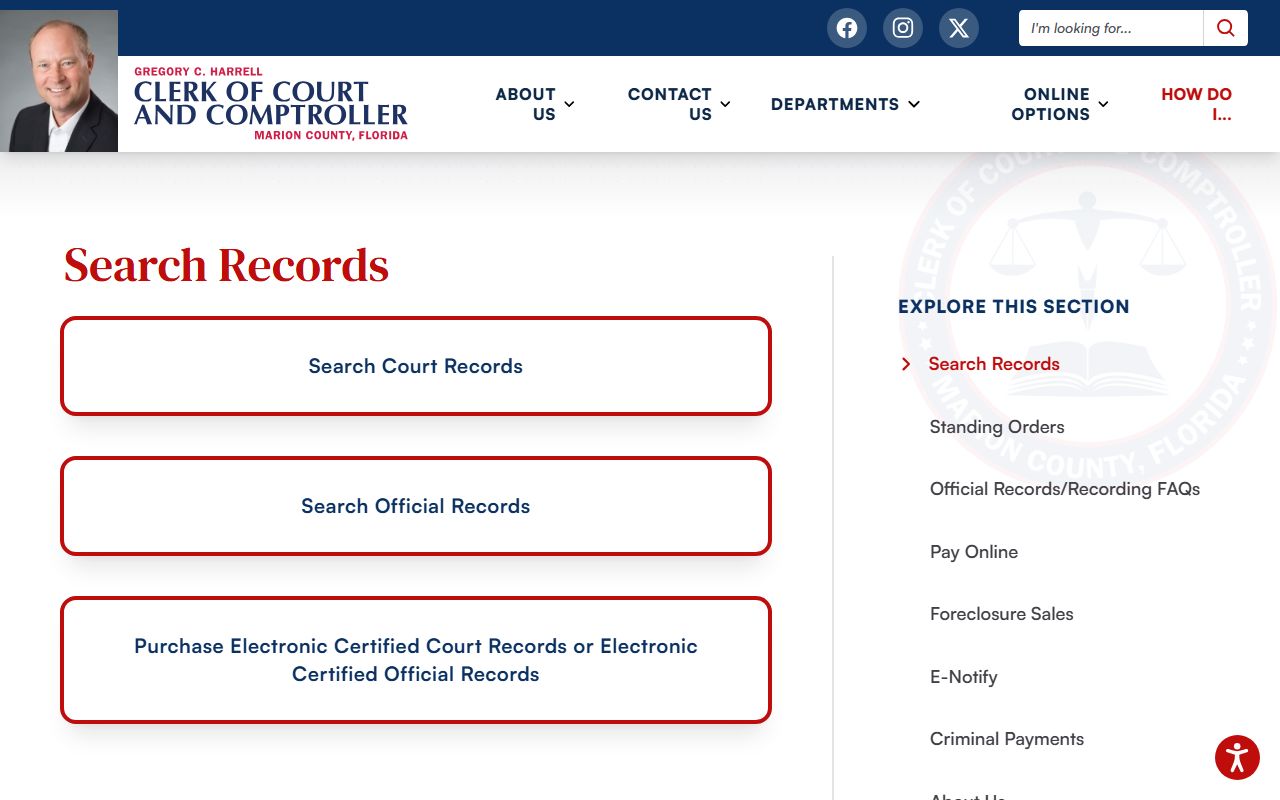
The page hands users off to OCRS for court cases and BrowserView for Official Records, which keeps the two record families clearly apart.
A clean five-step search using the public OCRS path looks like this.
- Open the Marion County OCRS access page and pick Public.
- Read the disclaimer and click I Agree to load the search form.
- Enter a last name, a first name or middle initial, or a business name. Add a date range or a court-type filter if needed.
- Finish the robot check, click Search, and review the result list. Open a case for the docket, parties, hearings, and disposition.
- If a certified copy is needed, request one from the Clerk through the certified electronic record purchase link or by contacting the office.
Public access has limits. Sealed cases, expunged cases, juvenile delinquency files, dependency files, and adoption files do not show up in public results. Some documents inside a public case may still be confidential or redacted under court rule. A docket entry is a line item, not always the document. For mortgages, deeds, and liens recorded after a judgment, users need both the court file in OCRS and the recorded instrument in BrowserView.
Note: Public OCRS results are informational; treat them as a guide, not as a certified court record for legal use.
The Marion County Judicial System
Florida courts run on a four-level model. At the top sits the Supreme Court of Florida, which handles death-penalty cases, certain bond validations, attorney and judge regulation, and court-rule changes. Below that are the District Courts of Appeal, which decide most appeals from circuit-court cases and many state-agency appeals using three-judge panels. Florida has twenty judicial circuits at the trial level. Marion County is part of the Fifth Judicial Circuit, along with Citrus, Hernando, Lake, and Sumter Counties. Each of Florida's 67 counties also has its own County Court for limited-jurisdiction matters.
Circuit courts hold general jurisdiction. They hear felony criminal cases, family law and divorce, probate, guardianship, juvenile, mental health, and most large civil disputes. County courts hold limited jurisdiction. They hear misdemeanors, traffic offenses, county and municipal ordinance cases, landlord-tenant disputes, small claims, and lower-value civil matters. Marion County's County Court work is filed alongside the circuit cases at the same downtown courthouse, and both share the unified Clerk's office.
Case flow follows a clear path: County Court › Circuit Court › District Court of Appeal › Supreme Court of Florida.
| Court | Jurisdiction | Case Types |
|---|---|---|
| Supreme Court of Florida | Top state court | Death penalty, rules, judge and lawyer discipline, select appeals |
| District Court of Appeal | Intermediate appellate | Most appeals from circuit court, many agency appeals |
| Fifth Judicial Circuit Court (Marion) | General trial jurisdiction | Felony, family, probate, guardianship, juvenile, mental health, larger civil |
| Marion County Court | Limited trial jurisdiction | Misdemeanor, traffic, ordinance, small claims, lower-value civil, landlord-tenant |
The Fifth Judicial Circuit publishes the local judge roster, hearing procedures, and program lists. Steven Rogers is named in administrative orders as the Marion County Administrative Judge. The bench also includes Jennifer Bass, Peter M. Brigham, Ann Melinda Craggs, Lisa Herndon, Robert W. Hodges, R. Gregg Jerald, Brad King, Barbara Kissner-Kwatkosky, Timothy McCourt, Shanae L. Pickens, Stacy M. Youmans, Lori Cotton, Robert E. Landt, LeAnn Mackey-Barnes, and Thomas P. Thompson III. Federal cases that arise in Marion County are filed in the U.S. District Court for the Middle District of Florida, not the local Clerk's office.
The screenshot of the Fifth Judicial Circuit Marion County page is taken from circuit5.org.
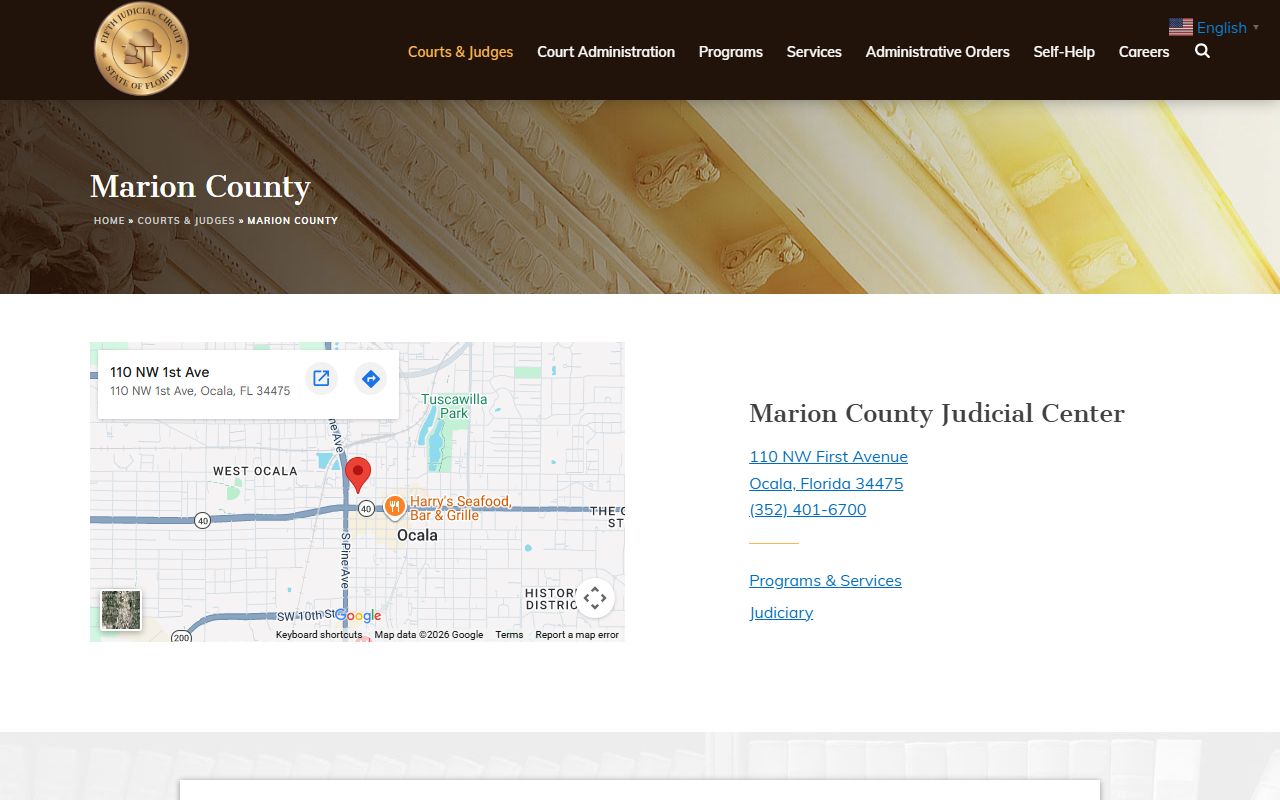
The page lists each judge, the Marion County Judicial Center address, and the specialty programs run inside the building.
Marion County Courthouses and Offices
The Marion County Judicial Center is the main court building in Ocala. It holds the Circuit Court, the County Court, judges' chambers, hearing rooms, the law library, and the Clerk's court-record desks. The Clerk also runs two more service sites. The Annex Building handles marriage licenses, passports, tax deeds, Official Records, and finance work. The Records Center handles records management. The Sheriff and the jail are in separate buildings on the north side of Ocala.
The full court complex is the fifth courthouse on or near the historic downtown square. It combines a 1963 original, a 1991 expansion that gave the building its current name, and a 2010 expansion that added five courtrooms and a large jury assembly space. The 1991 wing holds a cornerstone from the 1906 Marion County Courthouse that once stood on the square.
Clerk of the Circuit Court and Comptroller
110 NW 1st Ave.
Ocala, FL 34475
352-671-5604
Most public visits aim for the Judicial Center for court hearings or the Annex for a marriage license, passport, or recorded document. Mailing items to the Clerk should go to PO Box 1030, Ocala, FL 34478. The Clerk's Annex sits at 19 N Pine Avenue and uses 352-671-5588 for marriage-license help. Sheriff Central Operations is at 692 NW 30th Avenue, with a main phone line of 352-732-8181.
Types of Marion County Court Records
Court records in Marion County fall into a small set of broad case families. Each family has its own filing rules, fees, and access limits. Civil and criminal cases share many docket conventions, but family, juvenile, and mental health records carry tighter privacy rules. Traffic and ordinance cases use the County Court. Official Records, which include real-estate deeds and liens, sit in a separate index from court cases.
Each record family has its own OCRS court-type code. Code CF is felony. Code MM is misdemeanor. Code DR is family. Codes CP and GA cover probate and guardianship. Code CT is criminal traffic. Code TR is civil traffic. Knowing the code helps narrow a search when a common name returns too many hits.
- Criminal records - Felony and misdemeanor cases with arrest reports, charges, pleas, sentencing, and probation entries.
- Civil records - Circuit civil, county civil, small claims, eviction, and similar disputes filed by individuals or businesses.
- Family and divorce records - Domestic relations, dissolution, custody, child support, and injunction files coded DR.
- Probate records - Estate administration, will deposits, disposition without administration, and guardianship.
- Traffic records - Tickets and citations coded CT for criminal traffic or TR for civil infractions.
- Court dockets - Day-by-day case activity logs for any of the above court types.
The screenshot below comes from the OCRS Marion County access page.
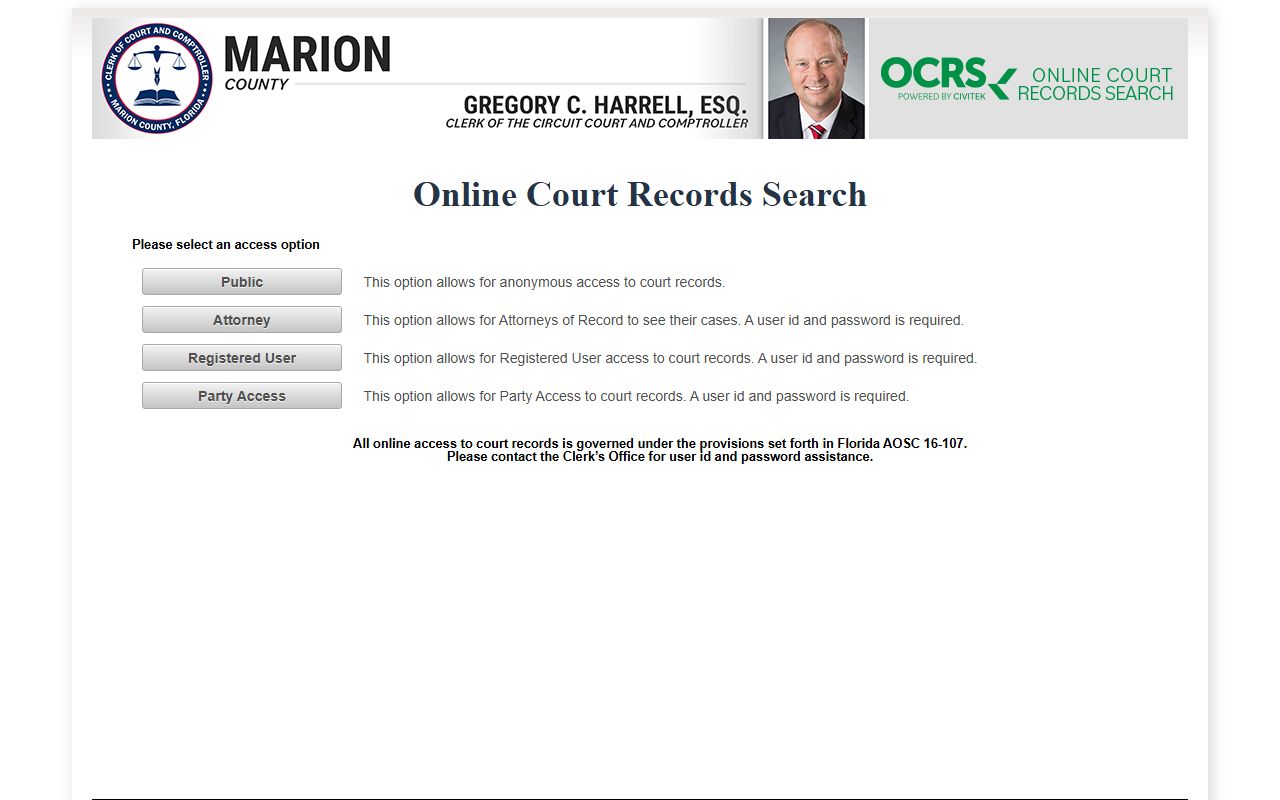
The four access tiles show how the same case file can be visible to a party or attorney, yet partly hidden from the public.
What Marion County Court Records Show
A case file at the Clerk holds a mix of identifiers, party data, docket entries, hearings, documents, and financial entries. Some fields are searchable in OCRS. Others appear only when a case is opened. Sensitive items, like Social Security numbers, bank accounts, and protected addresses, are masked or held back from public view under Florida court rules.
A field-by-field guide helps users read a result list and decide whether the matter is the right one.
| Field | What It Shows |
|---|---|
| Case Number | Year, court type, sequence, and division for each Marion County Court case. |
| Case Style / Caption | Names of the parties, such as State of Florida v. defendant, or plaintiff v. defendant. |
| Filing Date | Day the Clerk opened the case file. |
| Court Type | Code such as CF, MM, DR, CP, CT, TR, SC, or CC that places the case in the right court. |
| Parties | Plaintiff, defendant, petitioner, respondent, or business names. |
| Docket Entries | Motions, notices, orders, hearings, plea entries, judgments, and payment entries. |
| Disposition | Outcome of the case or each charge, such as guilty, not guilty, dismissed, or withhold of adjudication. |
| Sentence / Judgment | Final court order, fines, restitution, probation terms, or judgment amount. |
The Official Records browser uses a different field set, since it indexes recorded documents and not court cases. The screenshot below is from the NVWeb BrowserView page.
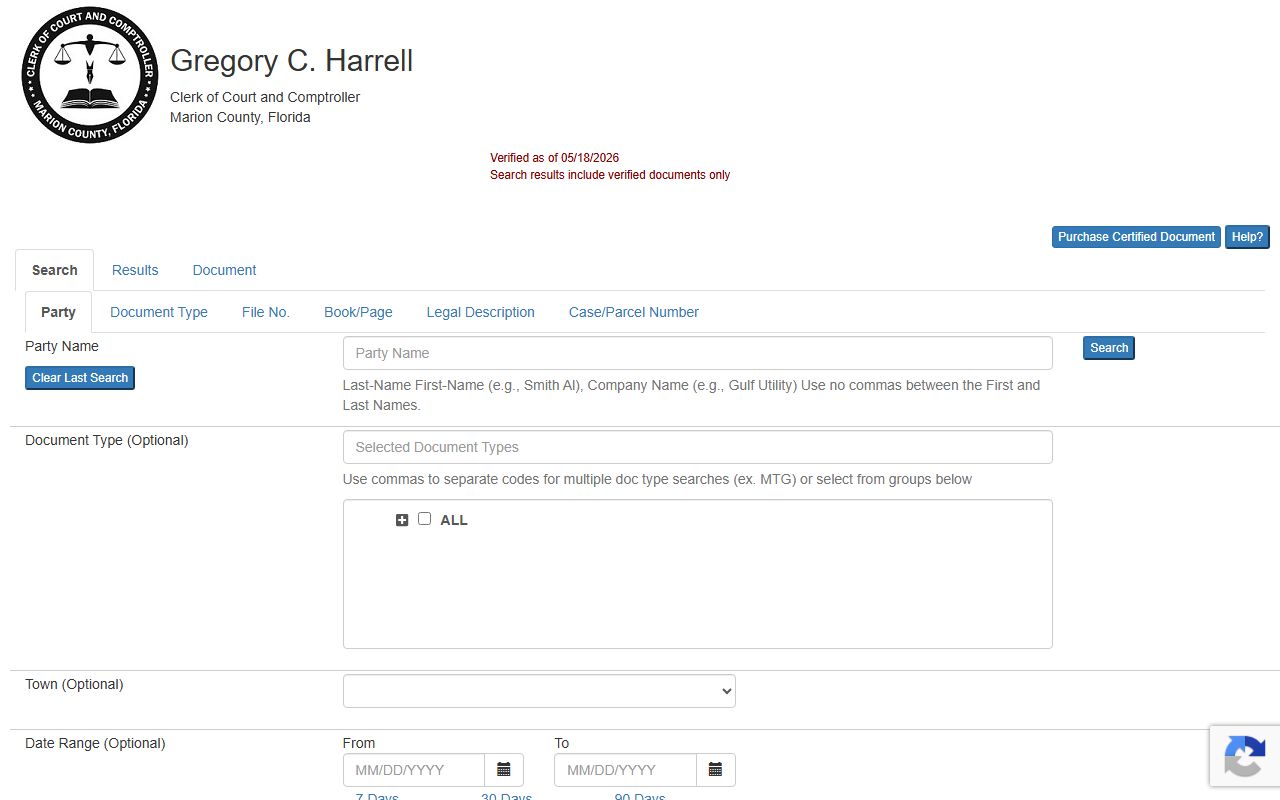
BrowserView accepts party name, document type, town, book and page, file number, parcel, and date-range searches for deeds, mortgages, liens, and other recorded items.
Many fields stay confidential under Florida Rule of General Practice and Judicial Administration 2.420. Filers must use a notice of confidential information when adding sensitive content to a public file.
Public Access Laws for Marion County Court Records
Florida has one of the strongest public-record systems in the country. The base rule sits in Article I, section 24 of the Florida Constitution, which gives every person a right to inspect or copy public records of state and local government. Chapter 119 of the Florida Statutes carries the day-to-day rules. Court files are also governed by judicial-branch access rules. The Marion County Clerk and the Marion County Sheriff both cite this framework on their public pages.
A few core statutes do most of the heavy lifting for court and county records.
Key Florida Statutes:
Florida Statutes § Chapter 119 - Sets the state policy that records made or received by public agencies are open for inspection and copying.
Florida Statutes § 119.011 - Defines public records broadly to include any material made or received in connection with official business, in any physical form.
Florida Statutes § 119.07 - Governs inspection, copying, fees, custodian duties, and the duty to state the basis for any claimed exemption.
Florida Statutes § 119.0714 - Adds court-file and Official Record protections, including masking of Social Security and bank-account numbers.
Florida Rule 2.420 - The judicial branch rule on public access to court records, sealed filings, and confidential information.
The official text of the public-records chapter is on the Florida Senate site.
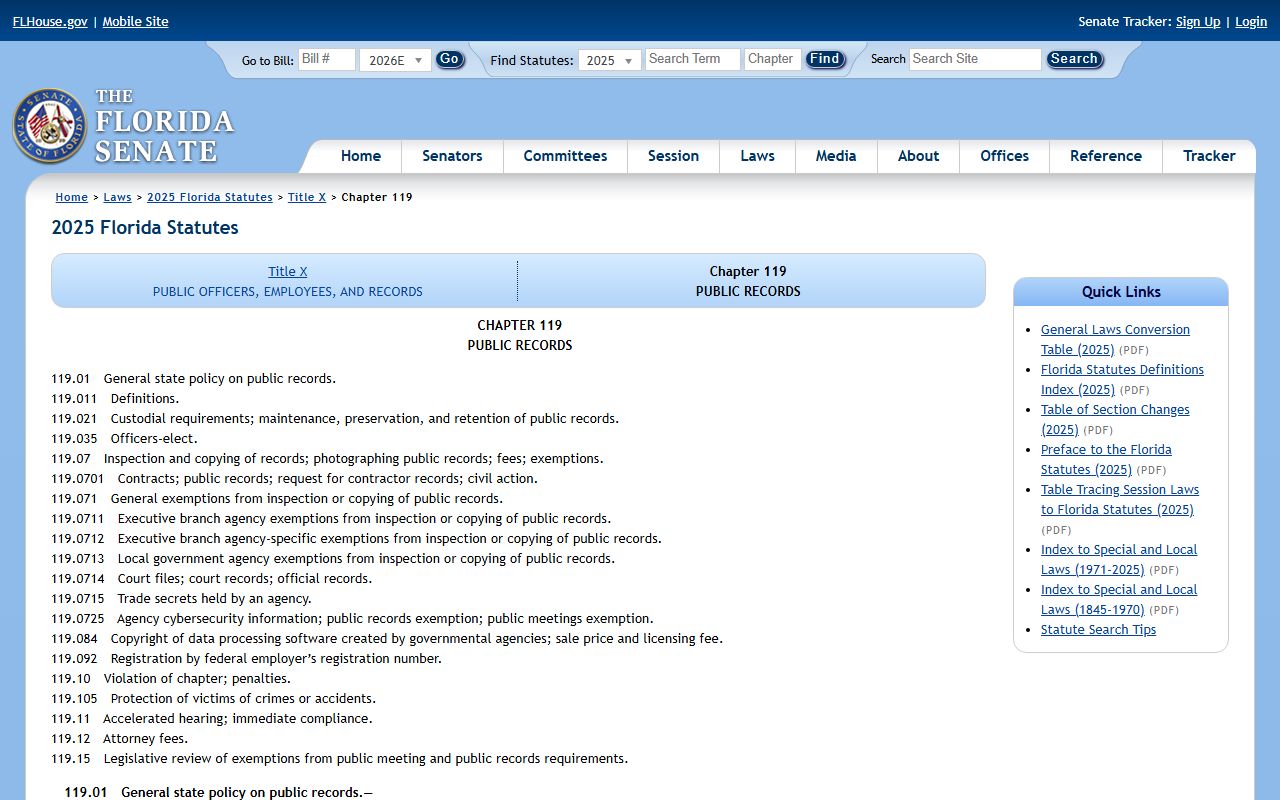
The screenshot is taken from flsenate.gov, and it shows the full chapter that governs requests to every Florida custodian, including the Clerk.
Florida Rule 2.420 is the court-side companion to Chapter 119. It tells clerks and filers how to mark a record confidential, how to file a notice, and how a person can ask a judge to seal or unseal a file. The official rule text is published by the Florida Supreme Court.
The PDF, hosted at flcourts.gov, is the same rule applied by the Marion County Clerk when filers ask to redact or seal court documents.
Restricted and Confidential Records
Not every court record is public. Florida law carves out a long list of confidential categories. Juvenile delinquency files are restricted under Florida Statutes § 985.04. Dependency files fall under § 39.0132. Adoption records are sealed under § 63.162. Mental health and Baker Act files are protected under § 394.4615. Sealed criminal records under § 943.059 and expunged criminal records under § 943.0585 do not show up in normal public search results.
To see a sealed or confidential record, a member of the public must file a motion in the court that holds the file. The motion must give a legal basis and serve any affected party. Some records can never be unsealed without a court order. A person who wants their own record sealed or expunged must first get a Certificate of Eligibility from the Florida Department of Law Enforcement, then file a petition in the original case under the right statute.
Note: A case that does not show in the public OCRS view may still exist as a sealed or expunged file, so a no-result screen is not proof that no record was ever opened.
Specialty Courts in Marion County
The Marion County Judicial Center hosts several problem-solving courts. These programs aim to cut repeat offenses by linking defendants to treatment, monitoring, and structured court review. The local list includes Adult Post-Adjudicatory Drug Court, the Misdemeanor Drug Court, DUI Court, Mental Health Court, Veterans Court, Teen Court, Juvenile Family Treatment Court, and Juvenile Treatment Court.
The misdemeanor drug court is a pre-plea diversion track. Eligible non-violent defendants who admit a substance-use disorder agree to treatment, peer support meetings, frequent drug screens, and personal court appearances. The program runs at least six months. Successful completion ends with dismissed charges. A felony pre-plea drug court track exists for eligible second- or third-degree felonies. Court Program Specialists at 352-401-7886 and 352-401-8146 staff the program.
Mental Health Court, Veterans Court, and DUI Court each pair court review with outside treatment partners. Juvenile courts add family-team meetings, schools, and child-welfare partners. Each track has its own judge assignment, eligibility test, and graduation rules. Defense counsel or the State Attorney usually flags a case for screening.
Marion County Sheriff and Jail
The Marion County Sheriff's Office is run by Sheriff Billy Woods. The Sheriff's bio describes him as a Marion County native with 36 years of law-enforcement work and three full terms in office. Sheriff Central Operations is at 692 NW 30th Avenue, with a main line of 352-732-8181. The Marion County Jail sits at 3290 NW 10th Street, Ocala, FL 34475, and is reached at 352-351-8077. The Sheriff's home page links the jail roster, the warrants page, victim services, and records.
The screenshot of the Marion County Sheriff home page shows the quick-link tiles.
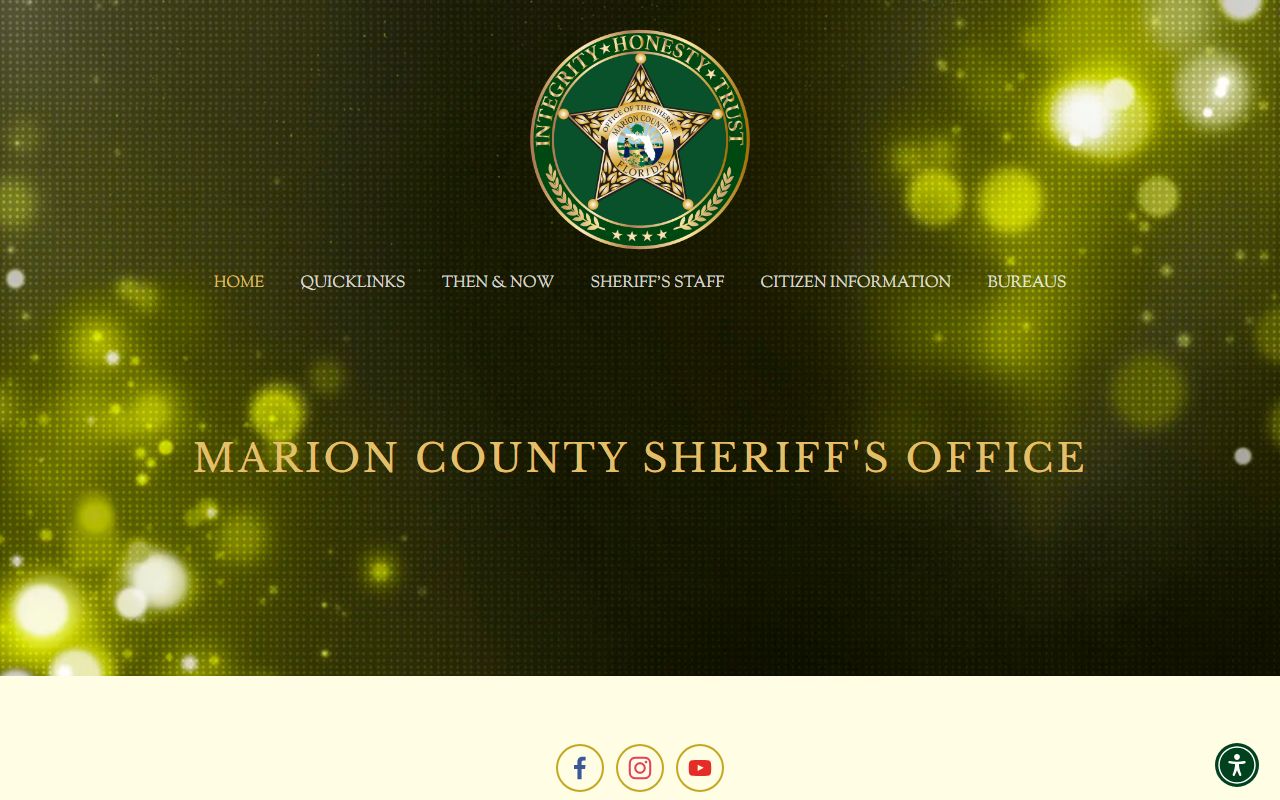
The same page routes users to the inmate search, the active warrant page, the Records Division, and jail visitation rules.
The jail's classification unit assigns each inmate to a pod, calculates release dates, checks release packets, and confirms warrants. Pod labels run from A-Pod through H-Pod, plus Medical Dorm, Worker Barracks, and the Infirmary. The Warrants Unit enters warrants into FCIC and NCIC, and is audited by FDLE and the FBI. The Sheriff Records Division at 352-351-6407 sells case-report copies at $0.15 per page, certified copies at $1.00, and local background checks at $5.00 plus $1.00 for each added name.
For a current roster check, use the Marion County inmate records page. For active warrants, see the warrant records page. Released-inmate notifications are tracked through released inmate records, and jail population data covers facility capacity and housing.
Marriage, Divorce, and Probate Records
Florida marriages, divorces, and estate matters all run through the Clerk in Marion County. Marriage licenses are issued at the Annex Building, 19 N Pine Avenue, Room 126. The phone for marriage help is 352-671-5588. Couples start the file through an online Marriage License Kiosk, schedule an appointment, and bring photo ID plus a confirmation number. The Clerk also performs short ceremonies for $30 and gives one certified copy at no extra charge. Divorce files are coded DR in OCRS and follow Florida family-law rules. The marriage and divorce records subpage walks through every step.
Probate work happens in the Probate Division of the Circuit Court, with the Clerk holding the file. Florida law gives a will custodian 10 days to deposit an original will after learning of the testator's death. Probate fees, will deposits, and disposition without administration are covered on the Marion County probate records page.
A short glossary helps users read these files.
- Testator
- The person who made the will.
- Executor
- Person named in a will to handle the estate; in Florida often called a personal representative.
- Conservator
- A court-appointed person who manages assets for someone who cannot do so alone.
- Guardian
- Court-appointed person with authority over a minor or a ward.
- Magistrate
- A judicial officer who hears certain matters under court rule.
- Petitioner
- The party who files a petition asking the court for relief.
Note: The Clerk's staff can hand out forms and look up files, but cannot give legal advice on a probate, divorce, or guardianship matter.
Marion County Court Records Fees
Most public users pay only a small per-page fee for copies. Certified copies cost more, since the Clerk seals and signs each one. Florida Statutes § 28.24 sets the statewide fee backbone, and the Marion County Clerk publishes a full Schedule of Service Charges. The Sheriff Records Division applies its own fee table for arrest reports and local background checks.
| Item | Amount |
|---|---|
| Sheriff case report copies | $0.15 per page |
| Sheriff certified copy | $1.00 per copy |
| Local Sheriff background check | $5.00 initial; $1.00 per added name |
| Notary service at Sheriff Records | $5.00 per stamp |
| Certified will copy at the Clerk | $1.00 per page plus $2.00 certification |
| Marriage ceremony at the Clerk | $30.00 |
| Extra certified marriage copy | $3.00 each |
| Keepsake marriage certificate | $10.00 |
| Clerical research after 15 minutes | $20 first hour; $5 per quarter hour after |
Online OCRS searches are free for the public view. Certified electronic court records and Official Records are sold through a separate Clerk purchase path linked from the Search Records page. Eviction forms can be bought at the Clerk for $0.15 per page or printed at no cost from the Clerk's eviction page.
How to Read Marion County Court Records
A case result list can look dense at first. A few habits help. Always check the court-type code. AP is an appeal from county court. CA is circuit civil. CC is county civil. CO is county ordinance. CT is criminal traffic. DR is family. CF is felony. GA is guardianship. MM is misdemeanor. MO is municipal ordinance. IN is a non-criminal infraction. CP is probate or guardianship. SC is small claims. TR is a civil traffic infraction.
The disposition line carries the outcome. A guilty plea, a not-guilty verdict, a dismissal, a withhold of adjudication, or a final judgment all sit there. A withhold of adjudication is a Florida disposition where guilt is not formally entered despite a plea or finding, subject to conditions. A dismissed with prejudice line bars refiling. A dismissed without prejudice line may allow refiling. A capias is a Florida-specific warrant that often issues after a missed court date.
Charges and convictions are not the same thing. An arrest on a Sheriff report shows what an officer alleged. A court disposition shows what the court ruled. A local background check at the Sheriff verifies arrest history only within Marion County, and the Sheriff FAQ tells users to follow up with the Clerk for the final disposition. The criminal records subpage explains the difference in more depth.
Accuracy and Record Limitations
Online court data lags real-time court action. A judge may rule on Monday, but the docket entry may post Tuesday or Wednesday after Clerk staff process the file. The OCRS disclaimer says the public information is for informational purposes and is not the certified court record. Sealed or expunged cases drop out of public search. Confidential filings may show only a docket label and no document image.
Names, ages, and addresses can also drift. A defendant who moved after a citation, or a party who changed a name after marriage or divorce, may appear under two index entries. Search variants help. Try a maiden name, drop a middle initial, or add a date range. For court-ordered changes, the right move is a written request to the Clerk with the case number and the supporting order.
Note: Confirm any case detail with the Clerk before relying on it for legal, employment, or housing decisions, since online records can lag the live court file.
History of Marion County Courts
Marion County's court story runs through the historic downtown square in Ocala. In the 1960s, county leaders chose to build a new courthouse instead of saving the old one. Proposals to convert the old building into a museum failed. The old courthouse was torn down in 1965. The County Commission then traded the site to the City of Ocala, keeping its public-square role as planned by the city's founders.
The current building is the fifth courthouse. It rolls three eras into one. The 1963 original sat on a new site away from the square. A 1991 expansion gave the building its current name, the Marion County Judicial Center, and added a cornerstone from the 1906 courthouse. The 2010 expansion added 146,520 square feet, five new courtrooms, a jury assembly area, more office space, and hearing rooms. Modern access has shifted online through OCRS, the Official Records browser, e-filing, e-recording, and certified electronic records.
The U.S. Census QuickFacts page shows the scale of the county that the court now serves.
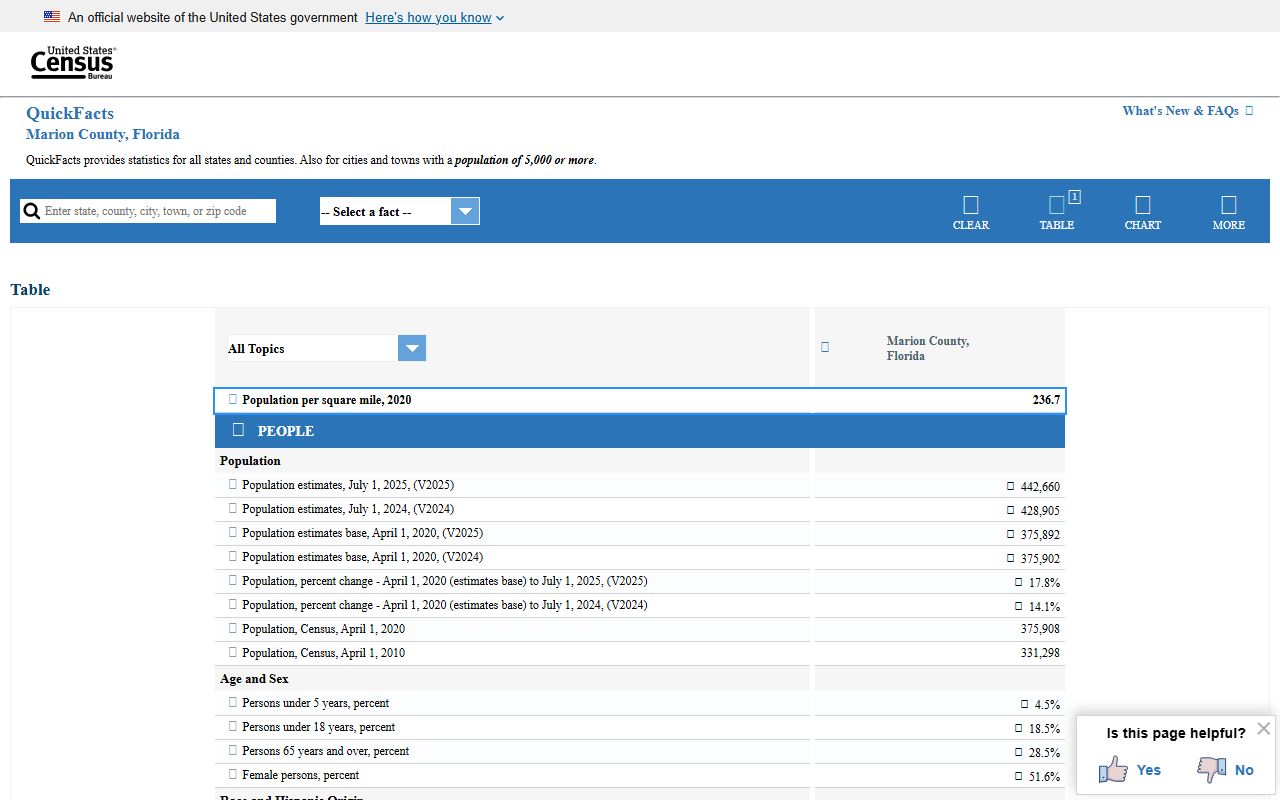
The data, taken from census.gov, lists a 2020 population near 376,000 and a 2025 estimate above 440,000 across a land area of about 1,588 square miles.
Frequently Asked Questions
How do I look up a Marion County Court case online?
Start at the Clerk's Search Records page and click Search Court Records. That link opens OCRS. Pick Public, accept the disclaimer, and enter a last name, a business name, or a date range. Court-type filters such as Felony, Misdemeanor, Family, Probate, Small Claims, and Traffic Infraction help cut noise. The public form needs at least a last name or a business name. Common-name searches do best with a date range or a court-type filter added in.
Is the OCRS result the official certified record?
No. The OCRS disclaimer is clear that the public view is informational and has no legal force. For court, agency, school, or licensing use, get a certified copy from the Clerk. The Clerk sells certified electronic court records and certified Official Records through a separate purchase link on the Search Records page. A walk-in or mail request to the Clerk's office at 110 NW 1st Ave., Ocala, FL 34475 also works.
Why can attorneys and parties see more than the public?
OCRS has four access classes. The Public tier is anonymous. Attorney, Registered User, and Party Access need a user ID and password. Florida Supreme Court access rules and Rule 2.420 give parties and attorneys of record a wider view of their own files, while limiting what the general public can see. The Marion County Court Records FAQ page has more answers along these lines.
More on the Marion County Court Records FAQ page.